




September 1 – December 5, 2026
Curator : Zoë Chan
Adapted for the LBEAG in collaboration with Nicole Burisch
With the participation of Derya Akay, Sara Angelucci, Dean Baldwin Lew, Patrick Cruz, Megan Kyak-Monteith, Ellie Kyungran Heo, Kosisochukwu Nnebe, Karen Tam, Tania Willard, Paul Wong, Marlene Yuen, and Shellie Zhang
Food and its diverse associated techniques, histories, and social interactions serve up a bottomless source of inspiration for artists. Indeed, food-related practices share significant parallels with art. As art historian Luce Giard compellingly argues in her essay “The Nourishing Arts,” the domestic processing of food is “a domain where tradition and innovation matter equally,” demanding “as much intelligence, imagination, and memory as those traditionally held as superior, such as music or weaving.”i
Unsurprisingly then, artists continue to delve into this rich subject matter, through multiple mediums. Showcasing artworks from the 2010s to the present, FOODWAYS focuses on a diverse selection of artists who explore food and food cultures, addressing a wide range of questions regarding cultural identity, personal narratives, community, and the transmission of knowledge. These layered artworks are often intersectional and embodied in nature, highlighting how ethnicity, culture, kinship, socio-economic status, geography, and colonialist histories percolate through practices linked to food and food culture.
Curator
Zoë Chan’s curatorial projects have explored a range of subject matter, including collaborative documentary, storytelling, youth, food, and diasporic identity. Curator at Richmond Art Gallery since 2022, she has curated exhibitions for institutions across Canada, including the Vancouver Art Gallery; Kamloops Art Gallery; Trinity Square Video, Toronto; Optica, Montréal; MSVU Art Gallery, Halifax; and the MAI (Montréal, arts interculturels).
CloseArtists & works
Artwork Becomes Dinner Party, 2023
Wood, ABS filament, metal
Various dimensions
Courtesy of the artist and Unit 17, Vancouver
Red and Yellow Shelf with Belvedere Lath, 2015/2020/2024
12 ounce to-go coffee cups, 12 pieces Turkish tea saucers, 3D printed alley rescue orchid (blooms white), 3D printed colchicine jar, 3D printed homegrown leek, 3D printed oncidium orchid, 3D printed vessel, apple cider vinegar, apples dehydrated at the Polygon, ashtray from Serdar, beads found in the garden, beans with bug hole polka dots, beeswax with dried dahlias, big boy crackers packaging, black Play-Doh, blown glass jar, borage flowers, bottle found in the Adriatic sea, brackets, bulgur, burnt old artwork ashes, calcium hydroxide pickled flowers, canola oil, cardboard box painted with acrylic, carrot seeds, cedar, ceramic cookie, ceramic ornaments, ceramic Turkish coffee pot, citric acid, clay orchids by Kingphaka, clotted cream, coriander, cumin, debris from Belvedere lath, dehydrated three stem cherry, deli cups, deli cups with pigments, dried butterfly pea, dried flowers, dried madder stem and leaves, dried spicy peppers, dye sublimation print, glass, glass jar, grandpa’s cigarettes, hibiscus, homegrown oregano, lead, leek and onion seeds, MDF, menus from “Estradiol Kitchen” at Moodswing Bar in New Westminster, BC, metal measuring cups, mint, mountain thyme, mustard oil, oblong ping-pong, olive oil, painted rock strawberry found in the couch at Pale Fire, paper fold widgets from anxiety, part of a pot I found somewhere, pennies used to make blue woodwash, Plaster pigment shelf, plaster relief of wheat I grew in the alley, plastic cherry blossom with tree stem, plastic clothespins, plastic lettering, pomegranate molasses, rice vinegar, Salem brand red hot pepper flakes, salt, studio mix herbal tea, studio mix tea #2, sumac, tape, tomato paste, trash from The Neighbour’s Plate exhibition, true cinnamon, unknown rock #1, unknown rock #2, Virginia gold tobacco that I grew in 2014, walnut husks, wood clothes pins, zaatar
Various dimensions
Courtesy of the artist and Unit 17, Vancouver
Vessels from Artwork Becomes Dinner Party, 2023
Ink on paper
121.92 × 121.92 cm
Courtesy of the artist and Unit 17, Vancouver
Making a Menu (Moodswing), 2024
Canvas, dye sublimation prints, paper, ink, pins, thread, and foam core with cedar artist’s frame
76.2 × 86.4 cm
Courtesy of the artist and Unit 17, Vancouver
Akay brings the home kitchen to the gallery. Dinnerware of various materials, sizes, and textures are stacked on the wall until they are activated to serve pastries. On the adjacent shelf is a record of the artist’s evolving artistic and personal practices. On display is over a decade of traces from Akay’s life by way of ingredients (e.g. beans, peppers, mint, etc.) family mementos (grandpa’s cigarettes), personal harvests (homegrown oregano and tobacco), and personal memorabilia (found items).
Derya Akay (they/them, b. 1988, Turkey) is an interdisciplinary artist and cook. Akay explores the tension between preservation and decay, control and chance, trial and error. Their process-based artistic strategies embrace the realities of time and transformation using organic materials.
EXPLORE
- In what ways are themes of heritage (cultural, familial, personal) elicited in Akay’s works?
- How does Akay use varying foodways as a means of documentation?
Bella di Notte: May 22 – Common Poppy, German Chamomile, Common Mugwort, White Garden Snail, Wall Barley, 2023
Nocturnal Botanical Ontario: June 30, Apples with LDD Moth Caterpillars, 2022
Nocturnal Botanical Ontario: July 25, Bee balm, Thimble weed, St. John’s Wort, Mallow, Water Iris, 2022
Nocturnal Botanical Ontario: September 21, Burdock, Wild
Strawberries, 2021
Bella di Notte: June 1 – Sambuco, Wax Leaf Ligustrum, 2023
Bella di notte, Artichoke #2, 2022
Bella flower, Caper berries & flowers, Common Hedge Parsley, Flax-Leaved Horseweed, 2023
Pigment prints on archival paper
119.38 × 86.36 cm
Courtesy of the artist and Stephen Bulger Gallery, Toronto
In these series, Angelucci illuminates what often goes unseen in the dark. Scanning the vegetation in her homes where she currently lives in Ontario, Canada and where her family originates in Le Marche, Italy, her compositions expose native and invasive plants and the creatures that inhabit and consume them. Via these images, she meditates on themes of family, migration, life, and loss and considers how her ancestors may have lived with the land as well as how to reckon with the colonial histories and politics of the lands on which she now resides.
Sara Angelucci is a Toronto-based artist working in photography, video and audio. Her work explores vernacular photographs and films, analyzing the original context in which images are made. Drawing attention to conventions of image making, her work foregrounds the cultural role vernacular images play in framing particular stories, creating histories, and memorialization.
EXPLORE
- Which elements are drawn out through the nighttime photography that may otherwise go unnoticed?
- Observe the array of plants depicted. Which, if any, do you recognize? What are their uses? Reflect on your relationships with the flora of your own home(s).
Dean Baldwin Lew
Wine, 2026
Evolving performative installation, furniture, wine press, grapes
Dimensions variable
Courtesy of the artist
Transforming the gallery into both a working studio and micro winery, Baldwin Lew renders visible a specific foodway, from grape to wine. Over the course of the exhibition, punctuated by activations by the artist and invitees, Niagara grapes are crushed, pressed, fermented, clarified, and, finally, bottled. Appropriating the university art gallery to create a space of social and biological activity, the artist recentres relationality and hospitality as artistic mediums. Visit our website for the schedule of activations.
Dean Baldwin Lew (b. 1973) gambols across installation, performance, and photographic media. A fourth-generation restauranteur who is Toronto-born and Montréal-based, he iterates on themes of hospitality, conviviality, performative still-life, and the structural discrepancies around which we pivot.
EXPLORE
- The installation display changes as a function of time. How does this temporal quality imbue a performative element into the work?
- The final drink is subject to many environmental variables during the growth of the grapes and the process of fermentation. What impact do you see this having on the artistic process? Does it translate to other mediums?
Kitchen Codex, 2021
Digital prints on textile
177.8 × 116.8 cm, 302.3 × 137.2 cm
Courtesy of the artist
Since 2015, Cruz has engaged in a practice of exchange, he receives a recipe, and cooks and serves a Filipino meal in return. In Kitchen Codex, these recipes, collected from Canada, Germany, Mexico, and Sweden, both typed and hand-written, are printed onto large textiles serving as tablecloths. Fashioning a sort of deconstructed, collectively-authored cookbook, the public is invited to take a seat at the table and become a part of this culinary community of exchange and reciprocity.
Patrick Cruz is an artist and educator who considers the role of spirituality, improvisation, intuition and play as emancipatory tools to reify embedded colonial frameworks and ideologies in art making. Cruz employs meditation, divination, and hypnosis as research methodologies to exhume and retrieve hidden knowledge.
EXPLORE
- Which of these recipes spark interest, curiosity, familiarity?
- What recipe from your family, culture, or hometown would you contribute, if you had the opportunity?
Large Feast on a Bed of Cardboard, 2019
Paint-on-glass animation, 46 sec.
Courtesy of the artist and Gabrielle Campbell
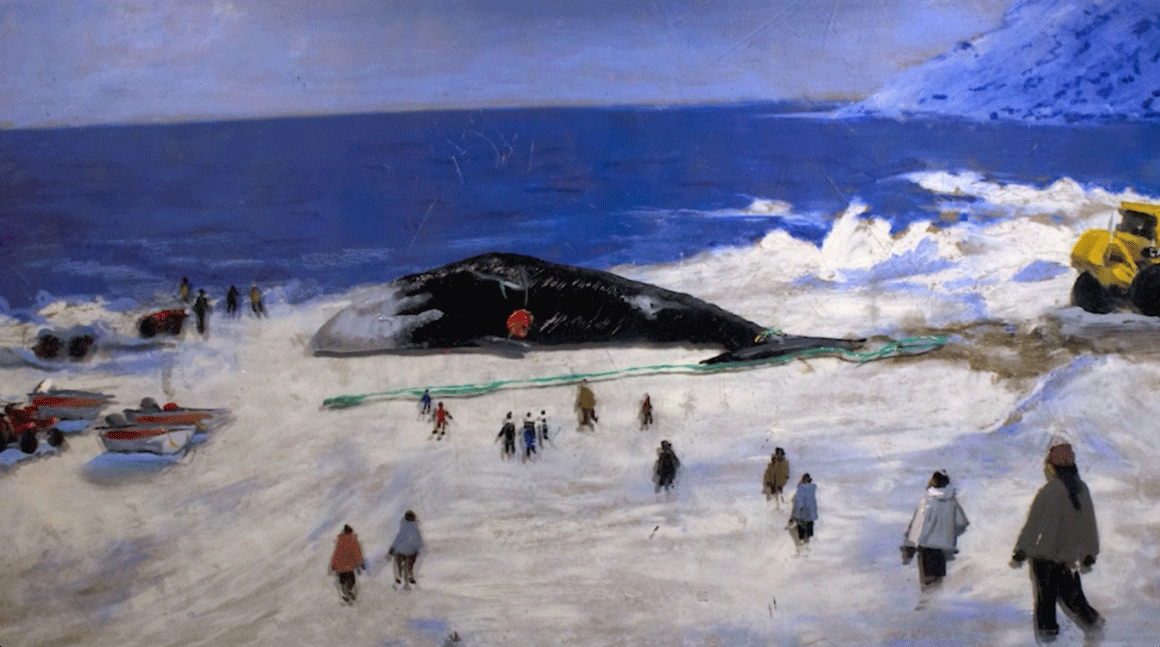
Whale Hunt: I Think Everyone is Here, 2019
Paint-on-glass animation, 56 sec.
Courtesy of the artist and Gabrielle Campbell
“Kyak-Monteith uses painting and stop-motion animation to capture the excitement and energy of a whale being pulled through snow onto an icy beach, as witnessed by an entire community. Moving easily from the panoramic to the domestic, she is as capable of bringing to life a sweeping scene of the landing and processing of a whale outdoors, as she is with an intimate close-up of manicured hands reaching for fresh meat cut into tidy cubes with the curved blade of the ulu, directly onto a piece of cardboard laid out on the kitchen floor. Rendered in a palette of vibrant colours with quick lively brushstrokes, these moments vividly highlight the cultural significance of this major intergenerational occasion of marine harvesting and sustenance for the Inuit.” – Zoë Chan
Megan Kyak-Monteith (b. 1997, Mittimatalik/Pond Inlet) is an emerging artist residing in Halifax, Nova Scotia. She graduated from NSCAD University in 2019 with a BFA in Interdisciplinary Studies, specializing in drawing and painting. She works as a freelance illustrator for children’s book and magazines articles and continues to paint from her home in Halifax.
EXPLORE
- How do the movements added by the stop motion influence the atmosphere of these two scenes?
- How is the artist reflecting on Inuit food cultures in these works?
Janchi Guksu (Banquet Noodles), 2016
Single-channel HD video, 4 min. 18 sec.
Courtesy of the artist and Lux Distribution, London
Did You Eat Rice?, 2017
Single-channel HD video, 53 min. 5 sec.
Courtesy of the artist and Lux Distribution, London
Across these two videos, Heo explores the preparation and labour involved in the East Asian staples: noodles and rice, both in the kitchen and in the field. Turning the gaze toward cultures of food production on the farm as well as at the table, Heo sheds light on the intimacies involved in how this work brings people together. The assemblages of tilling, picking, sorting, rinsing, sifting, and chewing against the backdrop of changing seasons, as well as solo and shared feasting, offer a meditation on what it means to care for a community, local and global alike.
Ellie Kyungran Heo is an artist who explores socio-ecological solidarity, conflict and coexistence through time-based media (primarily film) and inter-/transdisciplinary research. Attuned to intersecting equilibria and disturbances within interspecies, world-forming relationships, Heo exposes and reconfigures their complex entanglements and frictions through image, sound, text, and cross-sensory installations.
EXPLORE
- How does sound influence the atmosphere in these two works?
- How do the videos connect labour with community and culture?
A palimpsest for the tongue, 2025-ongoing
[Un palimpseste pour la langue]
Chlorophyll prints of archival photographs on banana and lotus leaves, LED light, glass
22 × 21 × 5 cm each
Courtesy of the artist
Following a residency in Maroon Town, Jamaica, Nnebe sought to trace the banana’s histories from subsistence crop for Marooned communities to modern commodity in global trade. Here, archival photographs were developed using sunlight on banana leaves in a process called chlorophyll printing. They feature ships and labourers carrying bananas as well as references to the United Fruit Company (1899-1970); itself a merger between two American rival banana trading companies. The work underscores the fruit’s role both for daily life as well as empire.
Kosisochukwu Nnebe is a Nigerian-born conceptual artist and writer. Working across installation, lens-based media and sculpture, Nnebe engages with topics ranging from the politics of Black visibility, embodiment and spatiality to the use of foodways and language as counter-archives of colonial histories.
EXPLORE
- In this work, the banana is employed both as a subject and as a material. How does this speak to the relationship art has in mediating situated knowledges?
- What other examples of foods that hold histories come to mind?
One Hundred Blossoms Lanterns, 2005-2007
Dragon & Phoenix (Lantern 1), 2005
The Tragedy of You (Lantern 2), 2005
Retreating Mountain (Lantern 4), 2005
Birds, Flowers, and a Lover’s Suicide (Lantern 5), 2005
Shrimp Cracking (Lantern 6), 2007
Eating Bitterness (Lantern 7), 2005
Citrus Wizard and Friends versus Dr. Fu Manchu (Lantern 8), 2007
Haiiee-yaa! Warrior and Cook (Lantern 9), 2005
Treasure Ship to Gold Mountain (Lantern 10), 2007
Handmade mulberry paper cutouts, Tyvek, wood, red tassels
41 × 28 × 28 cm each
Courtesy of the artist and Galerie Hugues Charbonneau, Montréal
“For me, the Chinese Canadian/Chinese American restaurant is a metaphor for Cathay or the idea of China in the West, and with [my] installations, I deconstruct and reconstruct the Chinese restaurant to see which elements signify meaning for the public and, thus, play a role in influencing Western perceptions of the Chinese. I use certain elements in restaurant décor seemingly present in almost every Chinese Canadian restaurant including lanterns. The imagery on these lanterns ranges and contrasts from traditional Chinese motifs to chinoiserie designs, characters from literature, racist political cartoons, silver screen actresses, historical and legendary figures.” – Karen Tam
Karen Tam 譚嘉文 is a Tiohtià:ke/Montréal-based artist and curator exploring the constructions and imaginations of cultures and communities through her installations. Since 2000, she has exhibited her work in North America, Europe, and China.
EXPLORE
- How does the artist employ signs, shapes, designs, and colours to communicate the Cathay metaphor and how have these signs circulated within the North American imaginary of China?
- What tales are conveyed across the different lanterns and in what ways are the lanterns playing with and against cultural histories and expectations?
Future Feasts, 2024
Laser cut print on used butcher paper
274.3 × 182.9 cm
Courtesy of the artist
Decoloniali-tea, 2024
Clay slip, glaze, dried herbs in hand-sewn cotton
Concept by Tania Willard, vessels designed in collaboration with Jesse Birch, wood fired with the Tozan Cultural Society, Nanaimo
Various dimensions
Refugitivi-tea, 2024
Clay slip and sgraffito, dried herbs in hand-sewn cotton, digital prints on textile
Concept by Tania Willard, vessel made by Myung Sun Kim
Various dimensions
Sovereign-tea, 2022
Clay slip and sgraffito, dried herbs in hand-sewn cotton
Concept by Tania Willard, vessel made by Brooke Waldron, Grayhorse Native Art and Ceramics
Various dimensions
DayDreamers Tea, 2022
Clay slip and sgraffito, dried herbs in hand-sewn cotton
Concept by Tania Willard, vessel made by Brittney Reitzel
Various dimensions
Fringe Labour, 2022
Nylon, deer hide, metal
182.9 × 182.9 cm
Courtesy of the artist
Future Berries, 2024
Metal, laser cut print on wood
58.42 × 60.96 × 81.28 cm
Courtesy of the artist
Oregon Grape Poem #1, #2, #3, #4, 2019
Oregon grape berry pigment on paper
74.93 × 55.88 cm
Courtesy of the artist and Scotiabank Global Art Program, Toronto
In this installation, Willard contemplates the urgencies of Indigenous food sovereignty. A tableau made of printed, used butcher paper serves as a cautionary reminder that all rests within a delicate balance. Various texts throughout also remind us about food’s origins, as well as sustainability and longevity, and that overextraction today is a theft from the future. The installation serves as a call to cultivate and consume responsibility – a practice closely tied to Indigenous resurgence.
Tania Willard is a mixed Secwépemc and settler artist whose research intersects with land-based art practices. Her practice activates connection to land, culture, and family, centering art as an Indigenous resurgent act, though collaborative projects such as BUSH Gallery and support of language revitalization in Secwépemc communities.
EXPLORE
- Willard invites visitors to “take time / visit long / prepare / harvest / repeat.” How do you respond to these instructions? What comes up for you in these actions?
- These works close the distance between the land and the food we consume. In response, how do you reflect on your own relationship to the origins of your food?
媽媽的藥櫃 Mother’s Cupboard, 2019
Inkjet prints
91.44 cm × 60.96 cm
Courtesy of Paul Wong Projects
“Wong honours the skills, knowledge, and frugality of his mother, Suk-Fong, by documenting her collection of Chinese herbs, medicinal ingredients, and hand-made tinctures that she preserved in recycled jars. The jars still bear the logos of inexpensive, well-known North American brands, over which she affixed her own handwritten labels identifying the contents and the date. Wong elevates the jars by displaying them in spacious configurations against brightly lit, white backdrops, worthy of glossy advertisements for luxury goods.” – Zoë Chan
Paul Wong is a pioneering figure, known for his innovative work in visual and media art. With a career spanning over five decades, Wong has continuously pushed the boundaries of storytelling, working outside mainstream conventions making art for site-specific spaces and screens of all sizes.
EXPLORE
- Vestiges of North American consumer products are repurposed as containers for Chinese medicines. How does Wong’s staging of these vessels bring out both of these geographies?
- Which of the brand names do you recognize? Which of the herbs?
Peace Together, 2024
Relief and screen prints on washi paper
Various dimensions
Courtesy of the artist
Interior of Hong Wo Store with customers, photograph, City of Richmond Archives, accession 1987 22 179
Yuen’s pop art screen prints on washi paper cover the front wall of the gallery. Investigating minor histories of Vancouver’s Chinatown, Peace Together is a product of archival research on the Richmond general store Hong Wo (1885-1977). Some of Hong Wo’s most popular inventory are represented in Yuen’s prints including staples such as Empire rice and Nescafé instant coffee, but also home goods like lanterns, rubber boots, paint, and even rat poison. The title, derived from “Hong Wo,” translates to “peace together” or “living in harmony.”
Marlene Yuen is a Vancouver-based artist who received her bachelors of studio arts in 1998 from the University of British Columbia. Yuen is a storyteller; she creates comics, prints and book works to convey stories. She weaves text and imagery to create sequential art.
EXPLORE
- How are foodways being used in Yuen’s installation to explore Chinese-Canadian histories?
- How are the pop art aesthetics of the prints (e.g., bright colours, repetition) placed in dialogue with archival research?
Bigger and Better than Ever, 2022
Neon and Plexiglas
76.20 × 76.20 cm
Courtesy of the artist and Patel Brown, Toronto
Bigger and Better than Ever 2, 2022
Neon
53.98 × 127 cm
Courtesy of the artist and Patel Brown, Toronto
Toronto’s Danforth Avenue has been a popular commercial thoroughfare since 1918. An early staple were the many fruit dealers, often run by Italian immigrants, whose storefronts would spill onto the sidewalks. Upset by this “misuse” of public space, other local businesses protested by encouraging all businesses to take up the sidewalks, resulting, ironically, in commercial success for many. The title is a nod to how this protest became a platform for these immigrant businesses. The fruit basket references an early logo of Vincenzo’s Supermarket, still in operation on the Danforth and family run since 1964.
Shellie Zhang (b. 1991, Beijing, China) is an artist based in Toronto and New Haven. Working across a range of media, Zhang explores how legacies of translation, migration, and memory leave traces and impressions across bodies, materials, and images. Her work examines processes of integration and assimilation, asking how culture is learned, negotiated, sustained, and transformed through lived experience.
EXPLORE
- Neon signs aim to entice passersby to enter. How do you respond to their call in the gallery?
- The work pokes fun at how the anti-fruit-dealer protests became a celebration of community-commercial activity. How does the aesthetics of the piece reflect this celebration?