




September – October 2026
Research residency by Larissa Fassler at Concordia University
BODIES OF KNOWLEDGE: THE ARCHITECTURE OF DISSENT
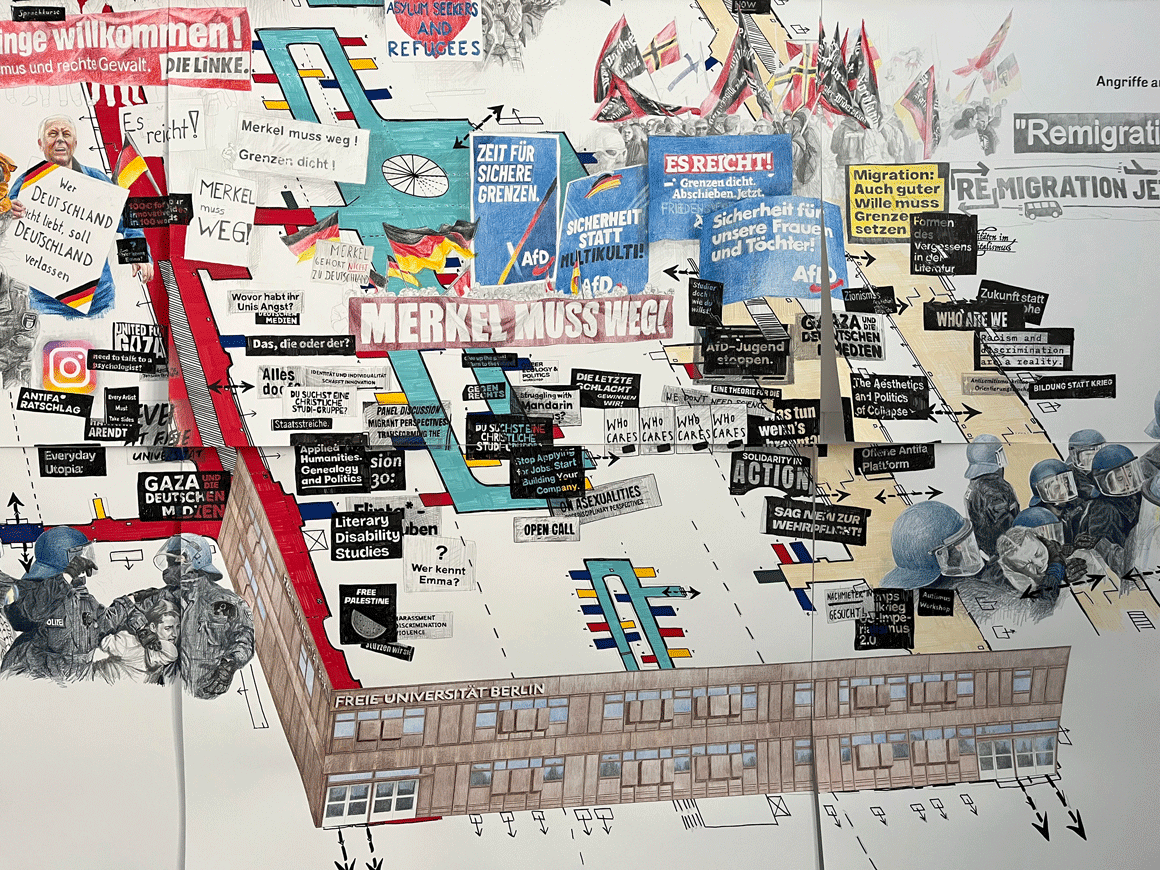
Bodies of Knowledge: The Architecture of Dissent is a new work by Larissa Fassler, the first of two drawings each measuring 2.8 x 4 metres.
The Freie Universität Berlin drawing maps sixty years of German political history onto a hand-drawn floor plan of the Freie Universität Berlin, a building designed by Candilis, Josic and Woods as a quietly radical alternative to Corbusian modernism, with entrances and exits throughout and deliberately ungated, an argument in architecture against hierarchy and control. The floor plan was reconstructed using Fassler’s own body as measuring instrument, walking and counting every space without architectural plans. This walking score runs as a structural armature through the drawing, colour-coded to the building’s original interior design.
Layered over and through this architecture: the student movements of 1968, the formation of German memory culture, the fall of the Berlin Wall, the Syrian refugee migration and the fracturing of German society, the rise of the AfD [Alternative für Deutschland / Alternative for Germany], and the deeply contested institutional and legal responses to Gaza solidarity protests on German campuses. The second drawing will map Concordia University in Montréal through the same method, tracing the student and political movements of that city, and the global forces that shaped them, across the same decades. Both works will be shown together at the Leonard & Bina Ellen Art Gallery, Concordia University, in the summer of 2027.
Fassler will be in residence in Montréal from September to October 2026, conducting on-site research at Concordia University, working in its archives, and immersing herself in the city before returning to Berlin to produce the Montréal drawing.
This fall, the Gallery welcomes Berlin-based artist Larissa Fassler for a research residency at Concordia University. From September to October 2026, Fassler will conduct on-site research, work in Concordia’s archives, and explore Montréal as she develops a new drawing that maps the university’s architecture alongside the city’s student and political movements.
Stay tuned for updates on her research and join us on October 29 at 3:00 PM for a conversation between Fassler and Shauna Janssen, taking place at 4TH SPACE and online.
BODIES OF KNOWLEDGE: THE ARCHITECTURE OF DISSENT
Bodies of Knowledge: The Architecture of Dissent is a new work by Larissa Fassler, the first of two drawings each measuring 2.8 x 4 metres.
The Freie Universität Berlin drawing maps sixty years of German political history onto a hand-drawn floor plan of the Freie Universität Berlin, a building designed by Candilis, Josic and Woods as a quietly radical alternative to Corbusian modernism, with entrances and exits throughout and deliberately ungated, an argument in architecture against hierarchy and control. The floor plan was reconstructed using Fassler’s own body as measuring instrument, walking and counting every space without architectural plans. This walking score runs as a structural armature through the drawing, colour-coded to the building’s original interior design.
Layered over and through this architecture: the student movements of 1968, the formation of German memory culture, the fall of the Berlin Wall, the Syrian refugee migration and the fracturing of German society, the rise of the AfD [Alternative für Deutschland / Alternative for Germany], and the deeply contested institutional and legal responses to Gaza solidarity protests on German campuses. The second drawing will map Concordia University in Montréal through the same method, tracing the student and political movements of that city, and the global forces that shaped them, across the same decades. Both works will be shown together at the Leonard & Bina Ellen Art Gallery, Concordia University, in the summer of 2027.
Fassler will be in residence in Montréal from September to October 2026, conducting on-site research at Concordia University, working in its archives, and immersing herself in the city before returning to Berlin to produce the Montréal drawing.
Larissa Fassler (b. 1975, Vancouver) is a Berlin-based artist whose drawings, paintings, and sculptures map the emotional, political, and physical contours of urban life. Trained at Concordia University (BFA) and Goldsmiths, University of London (MFA), she walks and measures sites using her own body before translating fieldwork, overheard conversations and signage, and archival research into dense hand-drawn compositions that expose how power and memory shape public space. Solo exhibitions include the Musée d’Orsay (Paris); Kunsthalle Lingen (Germany); the Currier Museum of Art (Manchester, New Hampshire); the Esker Foundation (Calgary); and the Canadian Cultural Centre (Paris). Group shows include the Chicago Architecture Biennial and the São Paulo Architecture Biennial. Her work is held in the National Gallery of Canada, the Berlin State Museum, FRAC Nouvelle-Aquitaine MÉCA, and the Deutsche Bank Collection. Featured in Artforum, Frieze, Canadian Art, and The New York Times; monograph published by DISTANZ (2022). Represented by Galerie Poggi, Paris.
Close