





May 13 – June 13, 2026
With the participation of Loïc Chauvin, Clara Congdon, Geneviève Dagenais, Hazel May Eckert, Melanie Garcia, Daniel Gillberg, ro heinrich, Sam Lee and Prune Paycha
Co-curators: Florent To Lay & Nicole Burisch
Read moreBetween describing an action and performing it, something slips. The work takes shape in that gap.
In this exhibition, each work is paired with a set of instructions devised by the artists. The aim is not to explain, but to suggest a way of doing things: instructions, verbs, protocols. These texts do not describe the works; they enact the conditions under which they appear. What matters is not only what is produced, but what resists execution.
Nothing is entirely fixed. At certain moments defined by these instructions, the works can be activated, moved, or modified in the presence of the public, changing their location, form, or rhythm. The exhibition becomes a space in motion, where the works are not merely displayed but put into circulation.
What follows is not a set of objects, but situations where forms shift, gestures repeat, and images appear and disappear. Each room proposes a way of doing, perceiving, or inhabiting the space—like a user’s manual.
***
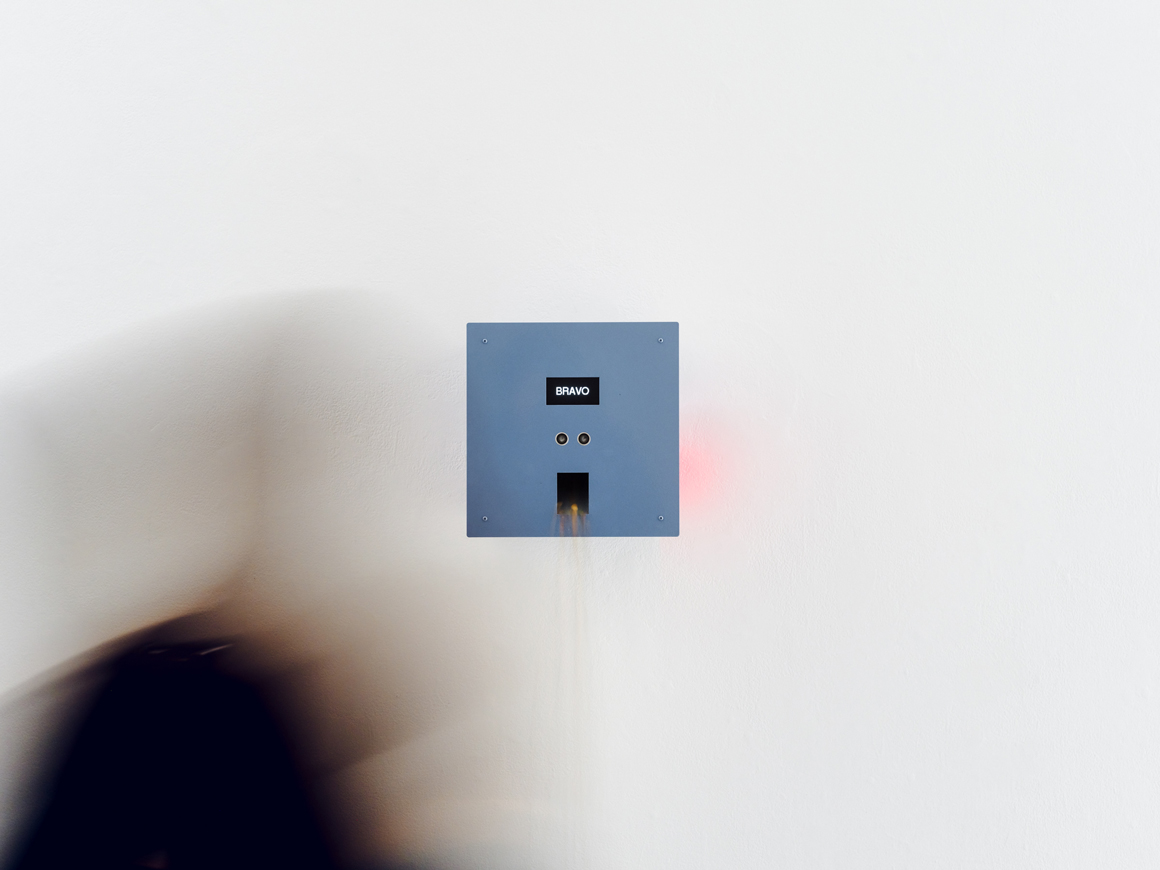
- The sound of dry rain echoes throughout the gallery. Machines wait patiently for us to approach. Something opens, and seeds now litter the floor. Are we the ones being rewarded?
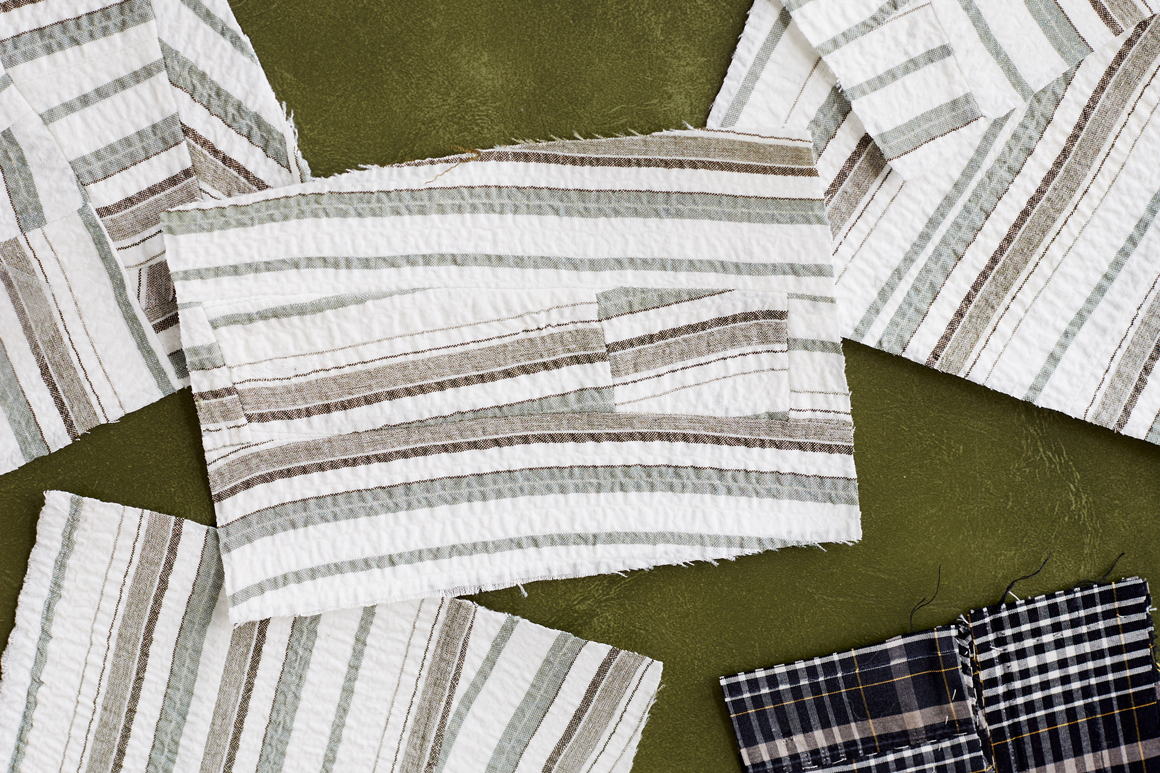
- On tables, fragments of fabric are carefully pieced together. The gesture is precise, repeated, recorded. Little by little, familiar shapes emerge and accumulate, with no intended recipient: letters, cards, traces of exchanges. The administrative gesture becomes a material one.
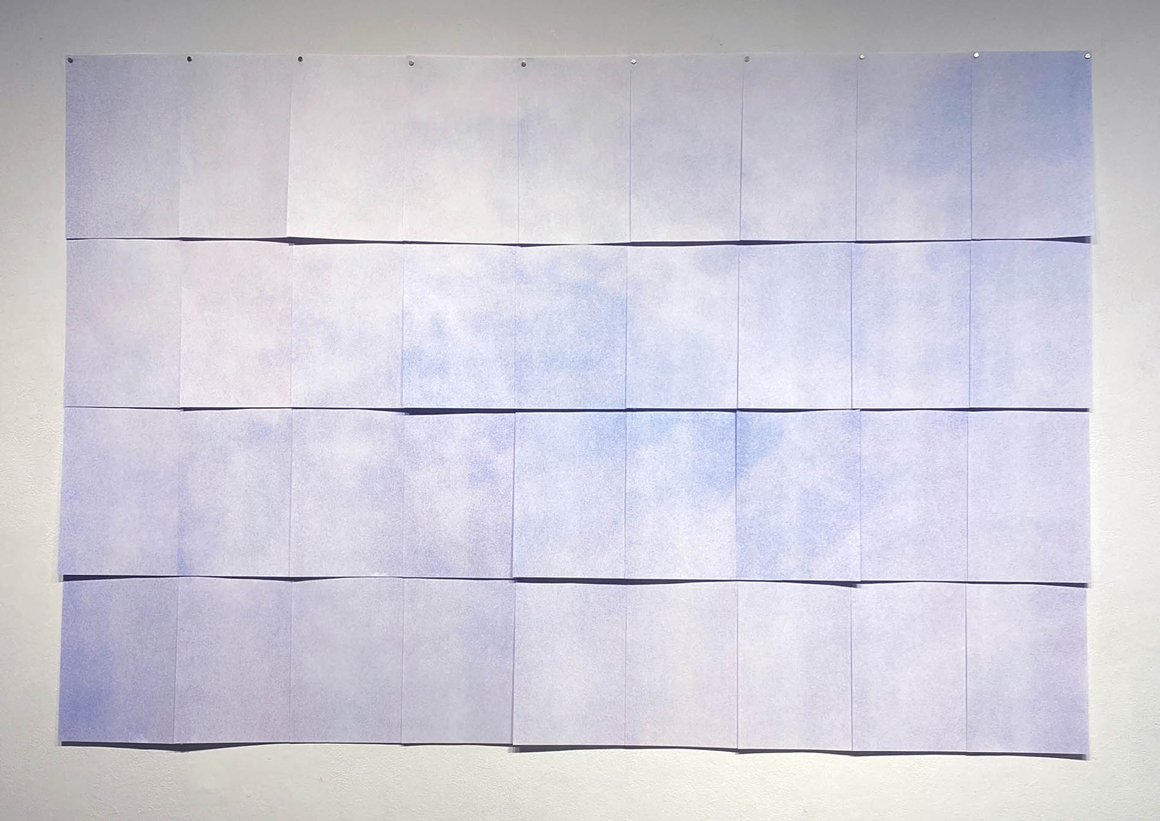
- A sky—the last one seen by a mother—is printed by her daughter in pink and blue, over and over again. The image multiplies, overlaps, transforms until it dissolves into its own repetition. The sky cannot be pinned down.
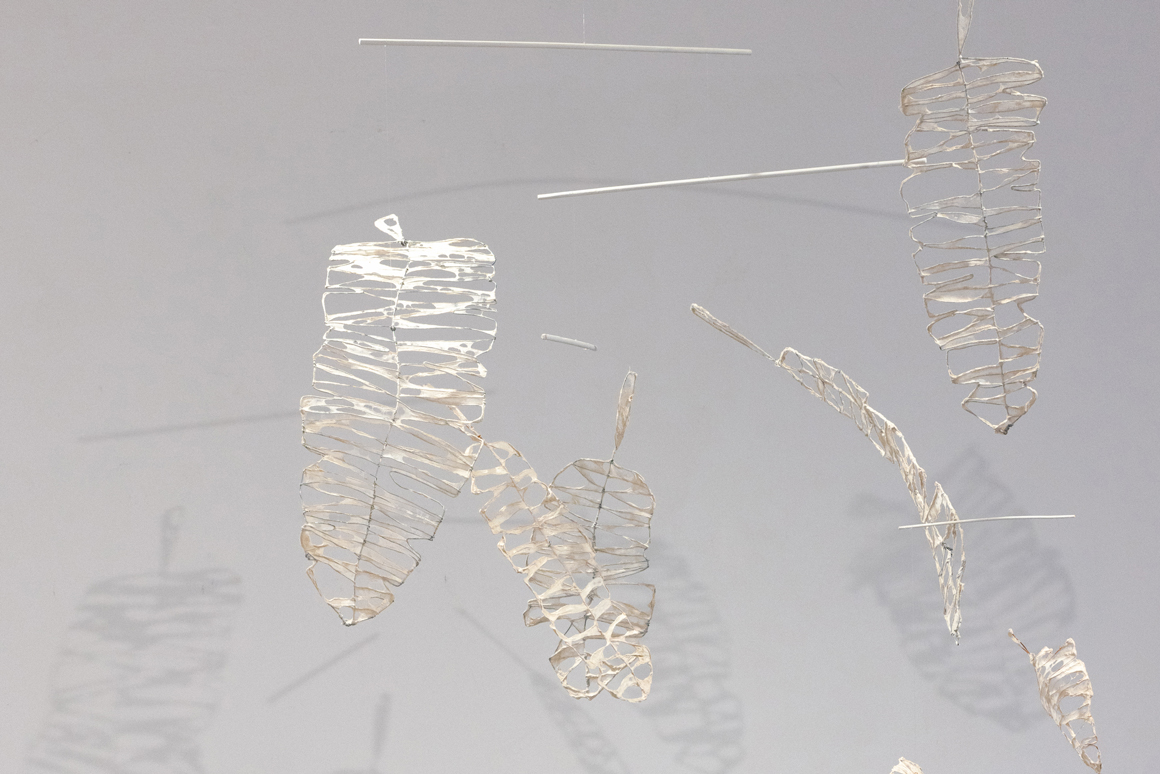
- In the air, abaca leaves native to the Philippines sway slowly. Each is hand-formed, dipped in paper pulp, imperfect. To repeat its form is to attempt to reach an origin that eludes us, a place passed down without ever having been experienced.
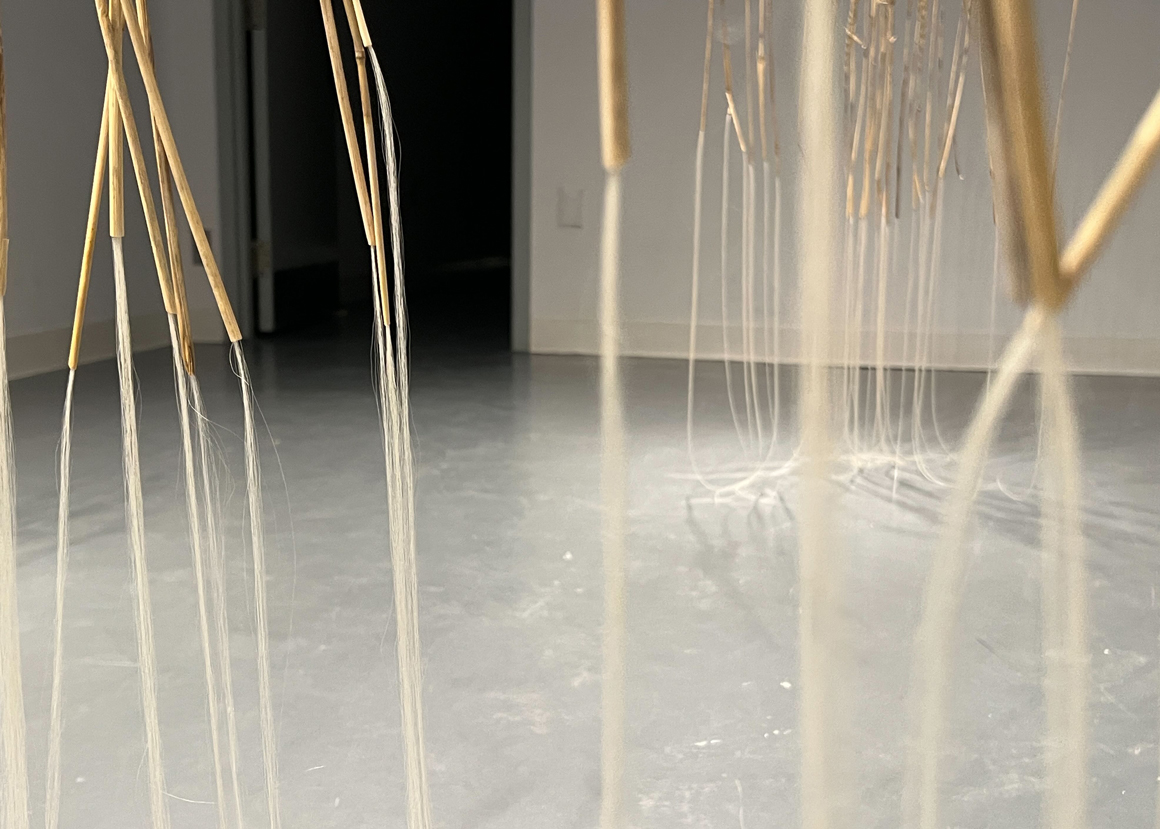
- In the same room, suspended tufts of beach grass occupy the space, intertwined with hair; their cut ends brush the floor. The plant and the human merge there. Where do we take root? How do we adapt? Navigating this suspended field is already a journey through these questions.
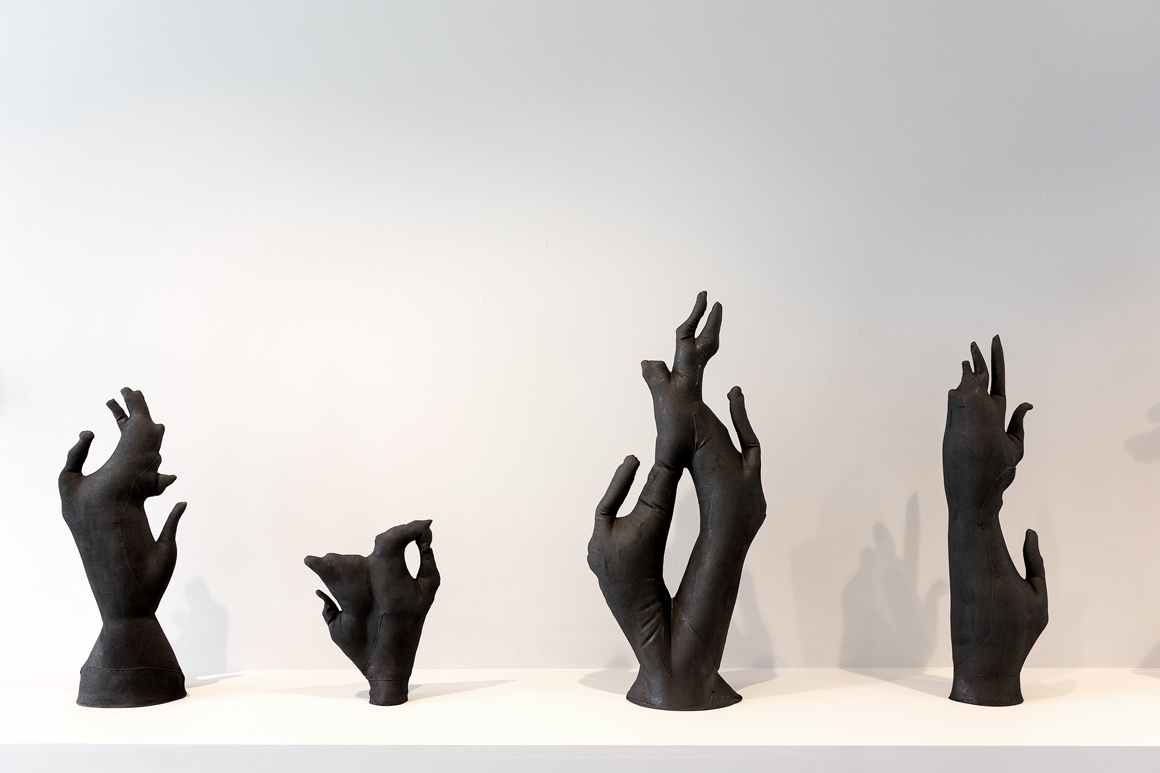
- Stoneware forms still bear the folds of the fabric that once held them. They are the frozen shadows of a body filmed in motion, translated into sewing patterns and then cast in clay. What remains: seams, folds, hollows—the petrified echo of a fleeting gesture.
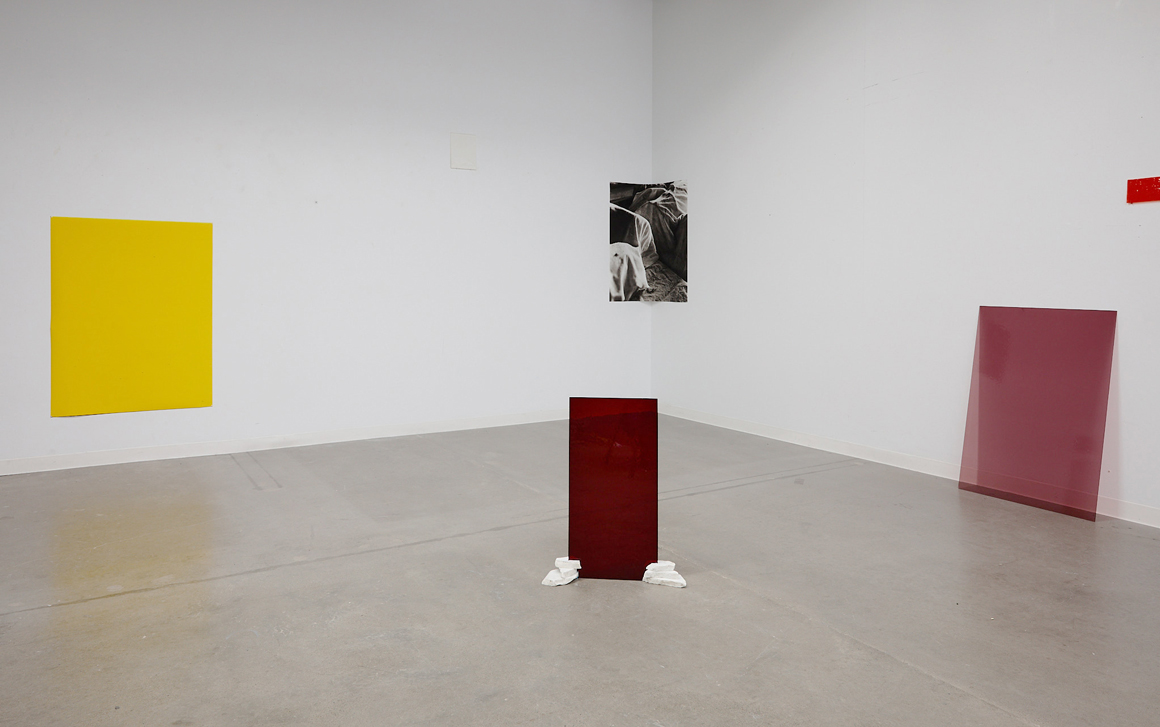
- A sheet of glass—or its imitation—barely held upright; a mirror with unreachable reflections; an image teetering on the brink of collapse. Whether they appear or fade depending on where one stands, whether they suggest one thing only to turn out to be another, all that remains of these images is the weight of their absence.
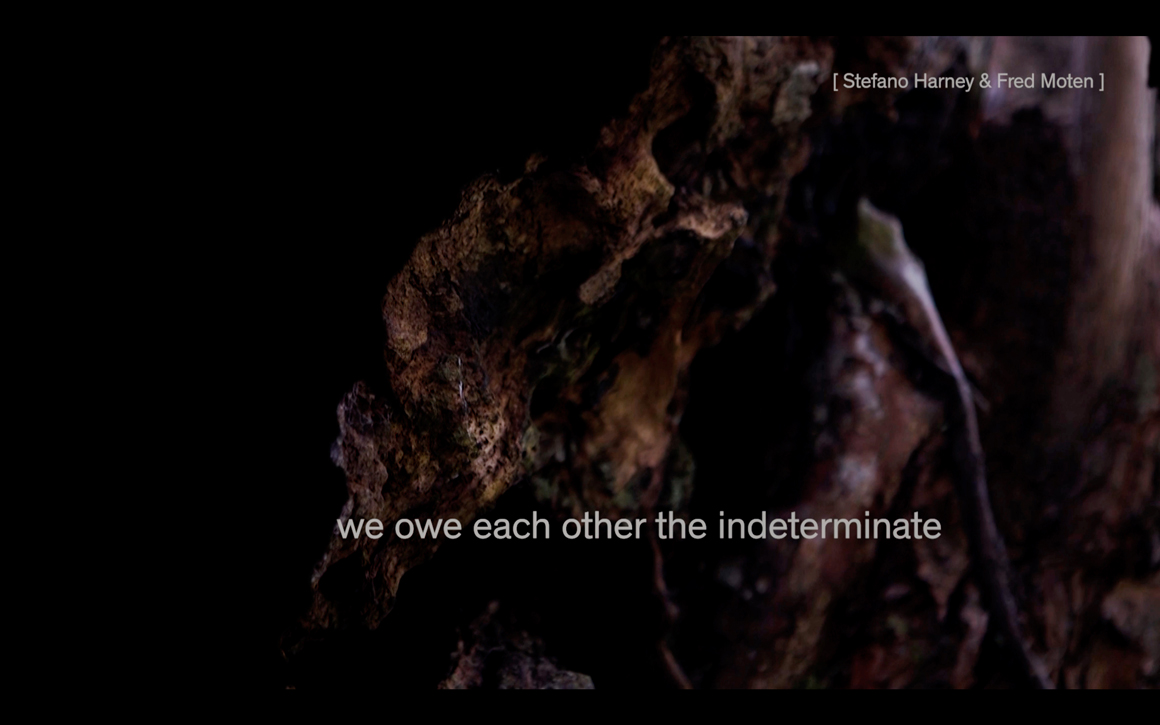
- Two films breathe at their own pace. The wind passes through them, sounds echo one another, thought stumbles, stutters, and reassembles itself. The films watch each other as much as they listen. At two points during the exhibition, they will spill beyond the screen to become participatory conversations.
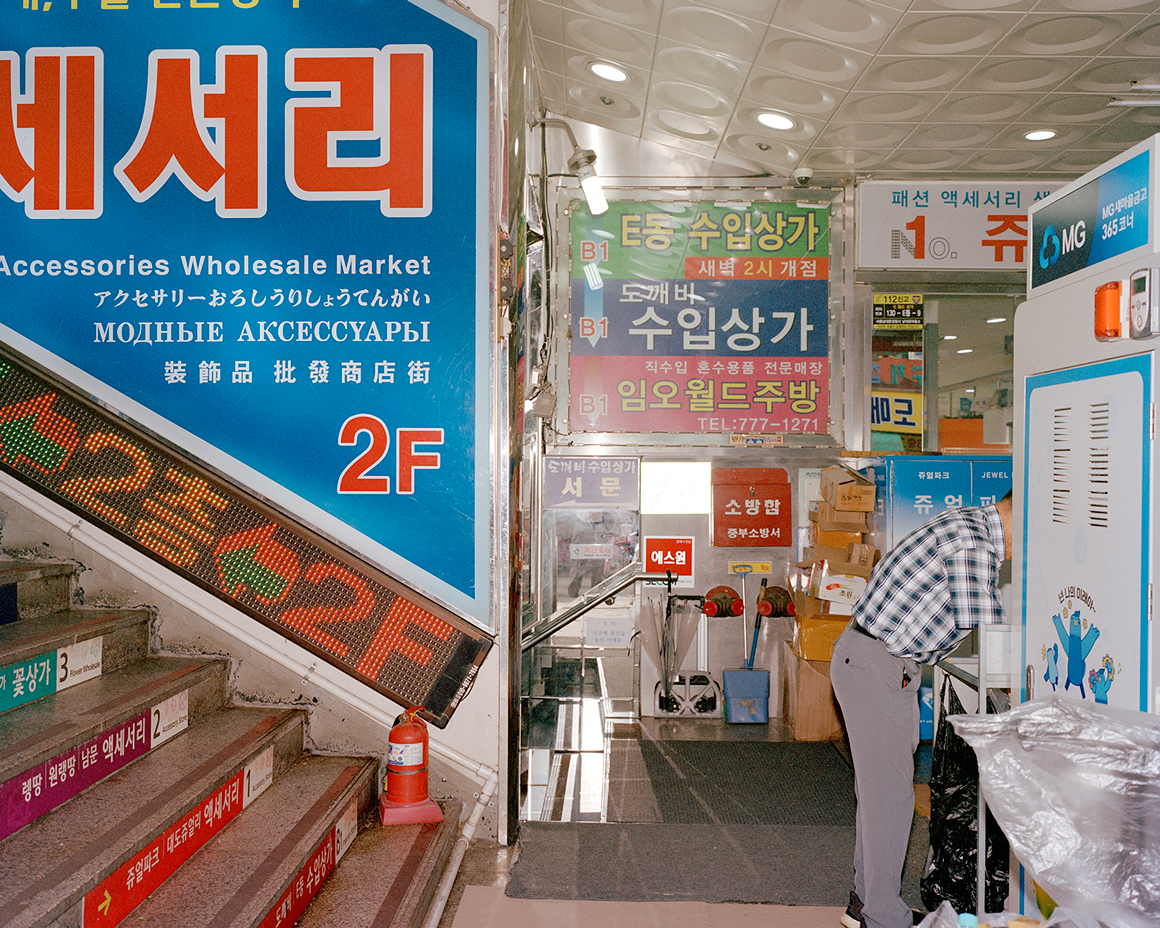
- Outside, a large photographic print, activated by daylight, explores South Korea’s productive frenzy through dense, silent market scenes. One can almost hear the tension of what flows without pause. 빨리 빨리 [ppal-li ppal-li], they say: hurry, hurry—a phrase that expresses the unstable balance between productivity and rest, commotion and calm.
***
Come on in.
– Florent To Lay
CloseIGNITION features new work by students currently enrolled in the Studio Arts, Humanities, or Individualized graduate programs at Concordia University. This exhibition provides an up-and-coming generation of artists with a unique opportunity to present ambitious, interdisciplinary works in the professional context of a gallery with a national and international profile. Students and the gallery team work together to produce an exhibition that places an emphasis on critical, innovative, and experimental work, engaging in the exploration and consideration of diverse media and practices.
The 21st edition was co-curated by Florent To Lay, Independent Curator and Executive and Artistic Director of SKOL, and Nicole Burisch, Director of the Leonard & Bina Ellen Art Gallery.
ARTISTS AND WORKS
Bleu pigeon (attends), 2026
[Pigeon blue (wait)]
Bleu pigeon (encore), 2026
[Pigeon blue (again)]
Bleu pigeon (désolé), 2026
[Pigeon blue (sorry)]
Interactive sculptures: electronic components, microcontrollers, OLED screen, ultrasonic sensors, motor, PLA printed components, painted aluminum, screws, organic pigeon feed
26 × 26 × 26 cm, each
Courtesy of the artist
Loïc Chauvin creates concrete situations in which simple devices subvert the viewer’s expectations: control machines that apologize, owl nesting boxes that hide from view, rolls of photographic paper disguised as silver maples. Often working with plants, animals, sensors, and protocols, his projects reveal the tension behind the desire to control living things. Drawing from natural science, minimalism, and surrealism, his works condense poetic gesture, material constraints, absurd humor, and a sense of strangeness.
Bleu pigeon is a series of interactive sculptures inspired by the experimental boxes designed by the American behaviorist B.F. Skinner (1904–1990) to study the conditioning of rock pigeons. The installation reinterprets these scientific devices as sensitive machines that respond to human presence. Each follows its own logic and expresses itself through the amount of birdseed it theatrically scatters onto the ground.
EXPLORE
- Approach the sculptures and read the messages they offer (attends, encore, désolé) as they simultaneously scatter bird feed at your feet. How do you interpret this offer? Is it welcoming? Encouraging? Disarming?
- The minimal design and interactivity mimics many retro and contemporary technological innovations. How do you see this work in dialogue with algorithmic relationships?
Scrap Paper, 2025–ongoing
Performance with worn clothing remnants, sewing thread, fusible interfacing, storage boxes, pattern pieces, pattern hook, chair, desk, fabric cutting table, ironing board, food preparation table, iron, distilled water, sewing machine, sewing tools, document sleeves, clothesline, clothespins, butcher paper
Variable dimensions
Courtesy of the artist
Clara Congdon employs patchwork, appliqué, weaving, knotting, folding, bookmaking, quilting, and collage techniques to re-organize by-products of her relationships and experiences. In rhythms of subtraction-addition and dissection-reconstruction, she contends with the impulse to “make use” of what amasses over time and reckons with ideas of containment, connection, record-keeping, and release.
Scrap Paper, as a process, is the assembling of kindred worn garment offcuts into standard image- and text-based document formats such as tabloid, letter, photograph, and business card. Scrap Paper, as an installation, is a series of workstations at which these documents are built, with each station offering a distinct labour context within which they can be read. The transformation taking place asks, how is knowledge scaffolded differently by image, word, material, and gesture?
EXPLORE
- Navigate the different stations. How does the artist transform garments into documents and what environments of labour do they evoke?
- The artist renders visible the labour processes of making within the installation. What do you notice about the assembling of discarded fabrics? What connections can be made with processes of memory and relationships?
as big as the sky, 2026
Plywood cyclorama, risograph prints on Japanese paper, wood, screws, pins
Variable dimensions
Courtesy of the artist
Hazel May Eckert’s interdisciplinary practice explores themes of memory, image circulation, and impermanence. Drawing on her background in visual art, graphic design, and print media, she works between large-scale installations and experimental artist books, using collage as both a conceptual framework and material strategy. She is interested in how images, objects, and organic matter gather and shed meaning over time—transforming, decaying, and retaining presence beyond their original contexts.
as big as the sky envelops visitors within an enlarged photograph of the sky—the last thing Eckert’s mother saw before her death. A single 35mm negative from the accident site in rural Manitoba has been magnified and tiled across overlapping risograph panels printed in pink and blue ink. Mounted on a curved framework reminiscent of film stage flats, the installation functions as a personal ritual made public. The labour-intensive lo-fi printing process with its glitches, grain, and repetition mirrors how grief operates: fragmentary, unstable, and ongoing.
EXPLORE
- Take in the grandeur of the assembled sky. Knowing what the artist has disclosed, how do you experience the sky (differently)? Where does it take you?
- How does the role of analogue techniques (film, risograph, stagecraft) in the creation of the installation shape its aesthetic qualities?
Leaves of Absence, 2026
Stainless steel wire, abaca pulp, cotton thread, aluminum, tree branches, bronze, manila rope mung beans, white beans, coconut, hair
Variable dimensions
Courtesy of the artist
Through the lens of her Filipino heritage, Melanie Garcia examines identity, place, and memory as someone born and raised in Tiohtià:ke/Montréal. Her work sifts through the effects of assimilation and dislocation, while questioning her relationship to the Philippines, a place she has never been. Despite her physical and cultural distance, Garcia seeks connection to familial cultural knowledge through archival images and symbolic language; weaving mutable narratives in an attempt to reconcile the known with the unknown.
Leaves of Absence reimagines the abaca plant — indigenous to the Philippines — as a fragmented cultural symbol of an exoticized elsewhere, simultaneously familiar and foreign, shaped by colonial trade and global circulation. Dispersed leaves, shadows, and interstitial voids create an indeterminate environment that responds to presence and movement. Through motion, balance, and negative space, the work frames identity as a process of becoming — formed through memory, rupture, and negotiation — while proposing materiality as an alternative archive for affective cultural knowledge.
EXPLORE
- The artist evokes the abaca plant both in the representation of its form as well as in her use of its pulp as a sculpting material. How does this attention to phenomenology serve to address Garcia’s quests for geographic reconciliation?
- What does the reference to mobiles inspire in you? How are notions of belonging negotiated through the work’s subtle movements, the shadows it casts, and the porosity of its negative spaces?
Threads from Deal Beach, 2025-2026
Suspended sand rye grass, synthetic fibre and human hair, organic cotton thread
Variable dimensions
Courtesy of the artist
Daniel Gillberg is a Swedish-born interdisciplinary artist based in Montréal. He has an ongoing engagement with overlooked material traces of human presence, such as street debris, discarded materials and plant matter. Drawing on a background in conservation, he works through processes of collection, re-contextualization and photography, creating installations and assemblages that explore how these traces hold presence and shape experiences of belonging within the built environment.
Threads from Deal Beach is an immersive installation consisting of a suspended field of sand rye grass, interwoven with synthetic and human hair. The work considers movement and transatlantic migration as processes of displacement and adaptation shaping both landscape and human lineage. As visitors navigate the field, bodily movement activates the work, making navigation and presence central to its experience.
EXPLORE
- The installation forms a meandering pathway, opening a space for slow observation and reflection. What do you notice through this choreography? What details of the installation emerge through a closer look?
- The weaving of the rye grass and hair assembles the outcroppings of both the landscape and the human body. How does this process of recontextualization serve to reflect on changing environments?
Ombre portée, 2025
[Cast shadow]
Stoneware, oxides, and India ink, audio poem written and recited by Nana Quinn
Variable dimensions
Courtesy of the artist
By manipulating materials in their transitional states, Geneviève Dagenais works around the concepts of printmaking and transmutation through textiles, ceramics, and casting, with the aim of evoking a perceptual and bodily experience of objects. She explores her relationship with gravity, weight, pressure, and balance.
Beginning with a performative corporeal exploration captured on video, Dagenais extracts a series of still frames depicting the intricacies of her moving body. She flattens these forms to create sewing patterns that serve as moulds to restore volume to what would otherwise be her cast shadows. The mass of clay poured into the flexible mold transforms the fleeting nature of movement by fixing it in time and matter.
EXPLORE
- How does the materiality of the sculptures (e.g., their texture, colour, weight, etc.) impact the sentiments of embodiment the artist evokes?
- What do the postures of the sculptures say about the relationship between movement, performance, and gender?
Neither Heavy Nor Fragile, 2025–ongoing
Glass panel, acrylic, marble, mirror, neon, photographs
Variable dimensions
Courtesy of the artist
Prune Paycha’s work explores the visibility conditions of images and the forms of perception that accompany them. At the intersection of photography and installation, she mobilizes light as a medium to examine the instability of images. Notably employing glass and mirrors, she creates installations in which images appear, fragment, or vanish, inviting viewers to engage in a situated and sensory experience of the gaze.
In Neither Heavy Nor Fragile, photographs, coloured glass, mirrors, and mineral fragments come together to create a space of tension between opacity and transparency, fixity and instability. The images, often drawn from subterranean environments or materials in transformation, (re)compose themselves according to the light and the viewpoint. The project offers a perceptual space in which the entire body becomes an eye; an eye that must be moved, adjusted, and engaged to experience the images and time.
EXPLORE
- How does the interplay between material and (in)visibility impact your experience of the images? What about the varying display mechanisms?
- What is your response to the artist’s provocation around the literal and metaphorical weight and fixity of the images? How does she explore the spectrum between heavy and fragile through the installation?
Strange Intruders, 2026
Single-channel video, color, sound
19 min.
The Being of Relation, 2025
Single-channel video, color, sound
9 min.
From the series The Being of Relation, 2024–ongoing
Courtesy of the artist
Sensation in its making. Sense, not seen. Speaks condensation. Activity pulses into sound, and pulls in marks. Inflecting, tempering, in the world. Orientation sickness swerves seasonal confusion. Colours cadence us into relearning again and again what starting in and with the field of relation can afford. An ecology of attentional pulls voluntarily attends to the metabolising of affect, of what happens at every turn; the tingling edges of emergence, differentiation, cut, blur, touch and transformation.
Pulsed by sense-making as an aesthetico-political practice, Strange Intruders and The Being of Relation are part of a collaborative, experimental film series led by ro heinrich. The films feature the voices of birds in protracted pulse and response, senses, stutters and relational thought growing through Erin Manning and Brian Massumi, bark twitches, quivers of winds, phonic pulls from Sher Doruff, Katrin Hahner. Feeling the interstices of perception, the films craft a rhythmic ecology of nonseparable sensing, where thought feels, sight touches, cadence potentiates.
Crafted towards a collective conversation, two public events (May 16, 2026 and May 23, 2026) extend film screenings and readings to engage the films’ (un)timely questions of how different logics, worlds, can be activated and practiced.
Strange Intruders lends its title from Brian Massumi’s The Personality of Power: A Theory of Fascism for Anti-fascist Life, 2025.
The Being of Relation lends its title from Erin Manning’s eponymous book The Being of Relation, 2025.
EXPLORE
- The films highlight the relations between entities and worlds both nonhuman and human. What do the films evoke for you, in reflecting on your own state of plural relations?
- The captions visualize not only the words spoken, but the theorists they refence as well as the tonal qualities of the enunciators (stammers, tongue clicks, breaths). How are these vocal utterances put in dialogue with the digital manipulations of the environments’ sights and sounds?
빨리 빨리 (hurry, hurry), 2025
Digital print on vinyl
391.2 cm × 492.8 cm
Courtesy of the artist
Sam Lee (he/him) is a Korean-Canadian visual artist and documentary photographer living and working in Tiohtia:ke/Mooniyang/Montréal. As a child of Korean immigrants, his practice is framed by his dual identity as a Korean and Canadian. His work employs visual investigations through photography to call attention to the social effects of globalization, immigration and colonization. His work mainly considers the Asian diaspora lens through which his experience is framed, but also keeping in mind his existence on unceded Indigenous land.
빨리 빨리 (hurry, hurry) is a photographic investigation on South Korea’s dramatic collective attitude of worker productivity and over-commodification. After decades of war and colonization, South Korea underwent massive economic growth. Industrializing and globalizing feverishly, the country has now become a global leader in several industries.
In the name of maximizing profit margins, this hustle-culture mentality has lifted many above the poverty line, but like many examples of the unchecked pursuit of capitalist gains, has resulted in side effects.
What has emerged is a fragile balance between seemingly incompatible forces: productivity and rest, turmoil and peace, concrete and nature.
EXPLORE
- A suite of signage, products, texts, and industrial lighting frame the solo figure in each of the photos. How do you read their expressions, body language, and social position?
- Do you notice your own embodied reaction to these images? How do they reflect or counter your own relationship to the themes of the global industrialization and the pursuit of capital over all else?