




February 26 to April 25, 2026
Curator: Ingrid Jones
With the participation of Natalie Asumeng, La Tanya S. Autry, Tony Cokes, Chantal Gibson, Tanya Lukin Linklater, Kosisochukwu Nnebe, Leanne Betasamosake Simpson, and Martine Syms
Read moreInspired by Claudia Rankine’s scholarship on microaggressions in Citizen: An American Lyric and themes of perceptibility, Labour seeks to unveil the invisible labour of the colonized. The exhibition challenges societal racial biases through the lens of Blackness and Indigeneity, exploring, among other concerns, how unseen labour might be unburdened and shifted onto the dominant. The evocative works of Natalie Asumeng, La Tanya S. Autry, Tony Cokes, Chantal Gibson, Tanya Lukin Linklater, Kosisochukwu Nnebe, Leanne Betasamosake Simpson, and Martine Syms examine white supremacy’s manifestation in institutional power paradigms and its corrosive effects on Black and Indigenous people and people of colour (BIPOC). In so doing, this exhibition operationalizes and reveals unseen labour while activating alternative teachings from Black and Indigenous perspectives. Labour asks, what are the motivations for our inclusion in institutional spaces? Who has the right to tell our stories? What is our right to rage in the face of microaggressions and discriminatory acts? And how can we employ much-needed rest as a form of resistance? By reimagining how the colonized perceive, engage with, and ultimately challenge the forces that shape our world, Labour becomes a powerful site of defiance.
CloseIntroduction
In 1979, commenting on the omission of significant engagement with feminisms from lower classes, the Global South, and lesbians, Audre Lorde reminds us to stand firmly in our differences and to transform those into strengths. She tells us that despite the pressures of institutions, such as academia, we need to be grounded in community as being key to our survival.
Institutional structures seek to extract our labour and ideas from their bodies of genesis in exchange for seductive offers of access to that which is often denied to the marginalized: power, wealth, security. The lie is that this is the only method to survive and to thrive, and that this can be gained by exchanging individuality, lived experience, and grounded normativity.i Lorde makes this fallacy clear with her famous utterance
the master’s tools will never dismantle the master’s house. They may allow us temporarily to beat him at his own game, but they will never enable us to bring about genuine change. And this fact is only threatening to those women who still define the master’s house as their only source of support.ii
This quote reminds us of two things. Firstly, that in order to dismantle systems of oppression, we need new tools, ideas, strategies; ones that come from our own communities and knowledges. And secondly, when we do rely on colonial tools and ideologies to prop ourselves up, this comes at the expense (or exploitation) of our community.
The exhibition Labour, curated by Ingrid Jones, assembles a group of eight contemporary Black and Indigenous artists (Natalie Asumeng, La Tanya S. Autry, Tony Cokes, Chantal Gibson, Tanya Lukin Linklater, Kosisochukwu Nnebe, Leanne Betasamosake Simpson, and Martine Syms) hailing from Canada and the United States whose works address these themes as ways of speaking back and speaking against dominant narratives of colonization and subjugation of racialized subjects.
The exhibition is divided into three sequential sections, each with their own thematic grouping: labour, rage, and finally rest. We can look at these themes as also being strategies of resistance against the violences of racism vis à vis micro and macroaggressions, suppression, invisibilization, and alienation. As you navigate the exhibition, you’re invited to read along with the sections below and reflect on your own experiences with these issues as well as your relationships to institutions and their investments in colonialism, white supremacy, and Eurocentricity.
i Coulthard, Glen, and Leanne Betasamosake Simpson. ‘Grounded Normativity / Place-Based Solidarity’. American Quarterly 68, no. 2 (2016): 249–55. https://doi.org/10.1353/aq.2016.0038.
ii Lorde, Audre. ‘The Master’s Tools Will Never Dismantle the Master’s House’. In This Bridge Called My Back: Writings By Radical Women of Color, edited by Cherrie Moraga and Gloria Anzaldúa. 1981. 2nd edn. Kitchen Table: Women of Color Press, 1983.
CloseEssay
Labour
Ingrid Jones
This text accompanies the exhibition
Labour
Curated by Ingrid Jones
With the participation of Natalie Asumeng, La Tanya S. Autry, Tony Cokes, Chantal Gibson, Tanya Lukin Linklater, Kosisochukwu Nnebe, Leanne Betasamosake Simpson, and Martine Syms
Montreal: Leonard & Bina Ellen Art Gallery (2026)
February 26 – April 25, 2026
As a collective phenomenon, the industrial exposition celebrated the ascension of civilized power over nature and primitives. Exhibition technologies tended to represent those peoples as raw materials; within the regnant progressivist ideology, they occupied the same category.
— Curtis M. Hinsley 1
[…] imperialism and colonialism brought complete disorder to colonized peoples, disconnecting them from their histories, their landscapes, their languages, their social relations, and their own ways of thinking, feeling and interacting with the world. It was a process of systematic fragmentation which can still be seen in the disciplinary carveup of the indigenous world: bones, mummies and skulls to the museums, artwork to private collectors, languages to linguistics, ‘customs’ to anthropologists, beliefs and behaviours to psychologists. To discover how fragmented this process was, one needs only to stand in a museum, a library, a bookshop and ask where indigenous peoples are located.
— Linda Tuhiwai Smith 2
Memory is a tough place. You were there.
— Claudia Rankine 3
When we speak of our labour, it is essential to remember how we, the global majority—wonderfully diverse and nonessentialist—came to be recognized, historicized and categorized in institutional spaces. We used to be the exhibitions. From the early 1800s, our bodies and our labour were on display in human zoos, world fairs, and industrial expositions. For predominantly white audiences, our songs, dances and traditions were the spectacle. An exploitative confirmation of our primitivity and white “imperial superiority” for the amusement of the masses.4 Like raw materials, our value was measured in what we produced or how much we entertained, and once depleted, our worth decreased exponentially. Cast as minorities, we were, and still are, bonded through our intersectional ties to colonization and, by extension, dehumanization. Our bodies were stolen, bought and sold, displayed and dissected, ogled, touched and forgotten at the whim of the dominant. 5 All facets of our distant proximity to whiteness, which, during the conquests, set the terms of our enslavement, torture and subjugation via the many enunciations of caste. 6
1 « La foire industrielle était un phénomène collectif qui célébrait l’ascension des pouvoirs civilisés au-dessus de la nature et des peuples dits primitifs. Les techniques d’exposition présentaient pour la plupart ces peuples comme des matériaux bruts ; au sein de l’idéologie progressiste dominante, ils occupaient la même catégorie. » Curtis M. Hinsley, « The World as Marketplace: Commodification of the Exotic at the World’s Columbian Exposition, Chicago, 1893 », dans Exhibiting Cultures : The Poetics and Politics of Museum Display, Washington (D.C.), Smithsonian Institution Press, 1991, p. 345. [Traduction libre]
2 « […] l’impérialisme et le colonialisme ont semé le chaos chez les peuples colonisés, les déconnectant de leur histoire, de leurs territoires, de leurs langues, de leurs systèmes sociaux et de leurs modes de pensée propres, de leurs manières de ressentir le monde et d’interagir avec lui. Ce processus de fragmentation systématique se fait encore sentir dans la répartition disciplinaire de l’univers autochtone : les ossements, les momies et les crânes aux musées ; les œuvres d’art aux collectionneurs privés ; les langues aux départements de linguistique ; les traditions aux anthropologues ; les croyances et les comportements aux psychologues. Pour constater à quel point ce processus a été fragmenté, il suffit d’aller dans un musée, une bibliothèque, une librairie et de demander où se trouvent les peuples autochtones. » Linda Tuhiwai Smith, « Imperialism, History, Writing and Theory », dans Decolonizing Methodologies : Research and Indigenous Peoples, 2e éd., Londres, Zed Books, 2012, p. 71. [Traduction libre]
3 Claudia Rankine, Citizen : ballade américaine, traduit de l’anglais par Maïtreyi et Nicolas Pesquès, Paris, Éditions de L’Olivier, 2020 [2014], p. 65.
4 Voir Tony Bennett, « The Exhibitionary Complex », dans Thinking About Exhibitions, New York, Taylor & Francis, 2005, p. 71–73. Disponible en ligne : https://doi.org/10.4324/9780203991534.
5 Ibid.
6 Voir Walter D. Mignolo, « Sylvia Wynter: What Does It Mean to Be Human? », dans Katherine McKittrick (dir.), Sylvia Wynter : On Being Human as Praxis, Durham (NC), Duke University Press, 2015, p. 106–123.
CloseCurator
Toronto-based curator and creative director, Ingrid Jones examines the intersections of decolonial curatorial practice, transnational solidarities, and the politics of museum representation. Her research engages themes of marginalization and refusal through installation, media, and collaborative projects. Recent initiatives address liberatory practices of the African diaspora (Liberation in Four Movements, 2024), the unseen labour of BIPOC artists and cultural workers (Labour, 2024-25), and nostalgia for racialized communities framed through white supremacy (Nostalgia Interrupted, 2022).
Jones co-founded Poor But Sexy (2009–2012), an independent art magazine recognized internationally for its collaborative approach, and Mutti (2018–2022), an artist space fostering community-based interdisciplinary project. She has curated exhibitions and programs for the Doris McCarthy Gallery (Toronto), SAVVY Contemporary (Berlin), and the Art Museum at the University of Toronto. She has also lectured and created masterclasses on photographic best practices and design for Toronto Metropolitan University and Sheridan Institute, respectively. Her work has been supported by the Ontario Arts Council, the Canada Council for the Arts, and the Reesa Greenberg Curatorial Studies Award, and featured in Vice Berlin and Art, Design & Communication in Higher Education, among others.
CloseArtists
Natalie Asumeng is a cultural worker and contemporary artist based in the Greater Toronto Area. Specializing in environmental soundscapes, photography, and video, she creates immersive installations that explore minimalism and themes of nature. Inspired by kankyō ongaku, a genre of Japanese environmental music, Asumeng integrates soundscapes into all aspects of her work, adding layers of auditory depth and crafting spaces that evoke deep emotions. Her art delves into memory, perception, and humanity’s relationship with its surroundings. By merging art with design, she enriches spaces with meaning and complexity.
CloseLa Tanya S. Autry is an art historian, educator, curator, and writer who believes in making cultural work liberatory praxis. She co-produced the global movement #MuseumsAreNotNeutral and has created exhibitions and programming via institutions and independent projects.
CloseTony Cokes (b. 1956) lives and works in Providence, Rhode Island, where he serves as Professor in the Department of Modern Culture and Media at Brown University. Cokes was awarded the 2022–2023 Carla Fendi Rome Prize in Art and Technology. In 2022, he was the subject of a major survey jointly organized by the Haus der Kunst and Kunstverein in Munich. Other recent solo exhibitions include Dia Bridgehampton, The Dan Flavin Art Institute, Bridgehampton, New York (2023–2024); Hessel Museum of Art, Annandale-on-Hudson, New York (2024); De Balie, Amsterdam (2022) ; Greene Naftali, New York (2022); Memorial Art Gallery, University of Rochester, Rochester (2021); MACRO Contemporary Art Museum, Rome (2021); CIRCA, London (2021); Museu d’Art Contemporani de Barcelona (2020) ; ARGOS centre for audiovisual arts, Brussels (2020); Carpenter Center for the Visual Arts, Harvard University, Cambridge, Massachusetts (2020); BAK basis voor actuelekunst, Utrecht, Netherlands (2020); Luma Westbau, Zurich (2019); Goldsmiths Centre for Contemporary Art, London (2019); The Shed, New York (2019); KunsthallBergen (2018); and REDCAT, Los Angeles (2012).
CloseChantal Gibson is an award-winning writer-artist-educator living on the ancestral lands of the Coast Salish Peoples. Working in the overlap between literary and visual art, her work confronts colonialism head-on, reimagining the BIPOC voices silenced in the spaces and omissions left by cultural and institutional erasure. Her altered texts, installations and graphic poetry collections bring a critical lens to the historical mis/representation of Black womanhood across cultural media. She is the author of How She Read (2019) and with/holding (2021).
CloseTanya Lukin Linklater’s artistic practice spans video, sculpture, and dance in museums. Sensation, embodied inquiry, scores, rehearsal, and being in relation (to ancestral belongings, communities, and weather) structure her work. Through citation of Indigenous peoples’ lived experience and cultural work, she honours practices and lineages that exceed dominant ideas of who we are. Her recent exhibitions include Gwangju Biennale, South Korea (2023); Aichi Triennale, Japan (2022); Toronto Biennial of Art (2022); New Museum Triennial, New York (2021); and San Francisco Museum of Modern Art (2019). Her solo exhibition, Inner blades of grass (soft) (cured) (bruised by weather), including works from the last ten years and new commissions, was presented by the Wexner Center for the Arts, Ohio (2024). She recently presented new performances at Camden Arts Centre, London, and Dia Chelsea, New York (2025). She holds a PhD in Cultural Studies from Queen’s University (2023). Her Sugpiaq homelands are in the Kodiak archipelago of Alaska.
CloseKosisochukwu Nnebe (she/her, b. 1993, Nigeria) is a neurodivergent Nigerian conceptual artist and researcher. Working across installation, lens-based media, and sculpture, Nnebe explores themes such as the politics of Black visibility, embodiment, and spatiality, as well as the use of foodways and language as counter-archives to colonial histories. Her work has been exhibited across Canada and internationally, including Art Museum at the University of Toronto, articule (Montreal), Artspeak (Vancouver), Plug In Institute of Contemporary Art (Winnipeg), and the Agnes Etherington Art Centre (Kingston), as well as NADA New York, the Bowling Green State University Gallery (Bowling Green, Ohio), Framer Framed (Amsterdam), Unfair Amsterdam, and the Photo Hanoï biennial (Vietnam). She participated in a residency with the Women Photographers International Archive (WOPHA) at El Espacio 23 (2024), a contemporary art space founded by Jorge M. Pérez in Miami. She was the recipient of the Guest Artist Space Fellowship (2023), initiated by Yinka Shonibare in Lagos, Nigeria, and was one of the two inaugural artists for NLS Kingston’s Sustainable Sculpture Residency (2023) in Maroon Town, Jamaica. In 2025, she undertook a year-long residency at the Jan van Eyck Academie in the Netherlands.
CloseLeanne Betasamosake Simpson is a Michi Saagiig Nishnaabeg scholar, writer, and musician. She is the author of eight books, including the novel Noopiming: A Cure for White Ladies (2020), which was shortlisted for both the Dublin Literary Prize and the Governor General’s Award for Fiction. Her album Theory of Ice (2021), released by You’ve Changed Records, was shortlisted for the Polaris Prize, and she received the Willie Dunn Award at the 2021 Prism Prize. Her most recent project, Theory of Water (2025), was published by Knopf Canada and Haymarket Books in the spring of 2025. Leanne is a member of Alderville First Nation.
CloseMartine Syms (b. 1988, Los Angeles) uses video and performance to examine representations of Blackness. Her work has been widely exhibited and presented in numerous institutions, including: Secession (Vienna), Institute for Contemporary Art (Virginia), Serralves Museum (Porto), Museum of Modern Art (New York), Hammer Museum (Los Angeles), Institute of Contemporary Arts (London), New Museum (New York), Museum of Contemporary Art (Los Angeles), and Studio Museum (Harlem, New York). She has lectured at Yale University, the University of Chicago, Johns Hopkins University, and MoMA PS1. Syms’ recent exhibitions include Loser Back Home, Sprüth Magers (2023); Grio College, Hessel Museum of Art (2022); and Neural Swamp, Philadelphia Museum of Art and Fondazione Sandretto Re Rebaudengo, Turin (2021–2022), among others. From 2007 to 2011, she was the co-director of the Chicago artist-run project space Golden Age, and she currently runs Dominica Publishing, an imprint dedicated to exploring Blackness in visual culture. She is the author of Implications and Distinctions: Format, Content and Context in Contemporary Race Film (2011). She is a faculty member in the School of Art at the California Institute of the Arts.
CloseWORKS AND EXPLORATION
Tony Cokes
Black Celebration: A Rebellion Against the Commodity, 1988
Single-channel video, black and white, sound
17 min. 11 sec.
Courtesy of the artist and the Museum of Contemporary Art Chicago
Gift of Marshall Field’s by exchange (2020.3)
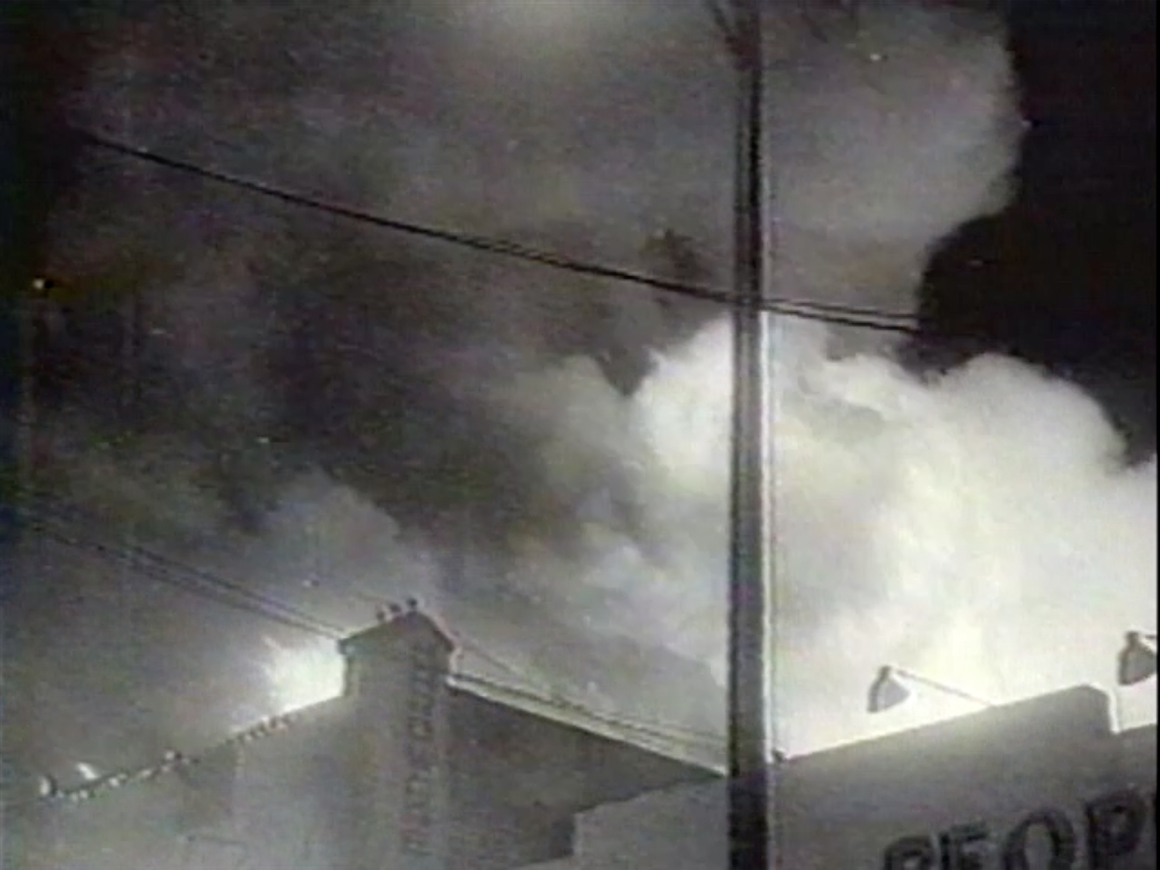
“In Black Celebration: A Rebellion Against the Commodity (1988), postconceptualist artist Tony Cokes troubles our understanding of looting through his reframing of the 1960s riots in Los Angeles, Boston, Newark, and Detroit. In each city, Black communities, dissatisfied with the uneven distribution of resources for their labour and the crushing systemic discrimination that saw them over-policed and oversurveilled, took to the streets and burned parts of their cities to the ground as they walked away with clothing, staples and electronics. iii Rather than play into the capitalist myth proclaiming that their labour would afford them equity, protestors risked their lives to turn the concept of commodification on its head. With Black Celebration, Cokes, whose works explore themes of racial representation, invisibility and hypervisibility, intentionally challenges the idea that the riots were criminal or irrational by foregrounding the conditions that catalyzed them.”iv
Kosisochukwu Nnebe
an inheritance / a threat / a haunting, 2022
Eight-channel video installation, black and white, sound
Courtesy of the artist
“In an inheritance / a threat / a haunting (2022), Nnebe plays with notions of discomfort by employing a cunning juxtaposition of the visible and invisible… we watch the artist’s seemingly innocuous preparation of cassava. The root vegetable, also known as manioc or yuca, was first used by the Indigenous in South America as early as 10,000 years ago. It was also cultivated in the Greater Antilles by the Arawak at the time of Columbus’ arrival. With the violent movement of explorers, traders, and the enslaved, cassava’s transport to the Caribbean and Africa increased, as well as Indigenous ways of processing. v
As much as cassava is known for providing sustenance, it is also known for its poison. The plant contains high levels of cyanide used by the enslaved in the “Thumbnail Method,” a deadly retaliation to colonial aggression.vi Through speakers bracketing the monitors, we listen only to the sounds of Nnebe’s labour as she reproduces the steps of the poison’s preparation in a manner that both displays and preserves the recipe’s secret. Cut, peel, grate, wring, putrefy, harvest, dry, powder, and load. vii Packed under a thumbnail; the powder could be covertly added to a drink or a meal. What might easily be mistaken for the loving preparation of a cherished family recipe now takes on new meaning.”viii
EXPLORE
- How does the theme of labour manifest within these works?
- How do the artists employ subversion as tactic to play with expectations and representations of Black bodies?
- What is the role that surveillance and performance play within these works?
iii Farrell Evans, “The 1967 Riots: When Outrage over Racial Injustice Boiled Over,” History.com, 2021, accessed August 17, 2024, www.history.com/news/1967-summer-riots-detroit-newark-kerner-commission.
iv Jones, Ingrid. ‘Essai Curatorial Curatorial Essay’. In Labeur Labour. Montreal, Canada, 2026. p. 27
v Christina Emery et al., “Cassava: From Toxic Tuber to Food Staple,” Plant Humanities Lab, Dumbarton Oaks and JSTOR Labs, January 21, 2022, accessed July 28, 2024, https://lab.plant-humanities.org/cassava.
vi Ibid.; Nya Lewis and Kosisochukwu Nnebe, “Kosisochukwu Nnebe in Conversation with Nya Lewis,” YouTube, C Magazine, February 27, 2023, accessed July 28, 2024, https://youtu.be/G7wcPzW_RcU?si=90w2rgk0PNYQ0-_7.
vii Kosisochukwu Nnebe, “an inheritance,” Coloured Conversations, 2022, accessed July 28, 2024, https://www.colouredconversations.com/an-inheritance. [URL no longer active]
viii Jones, Ingrid. ‘Essai Curatorial Curatorial Essay’. In Labeur Labour. Montreal, Canada, 2026. p. 33-36
CloseLa Tanya S. Autry
Inclusion Ruse, 2023-24
Audio manifesto, 5 min. 37 sec.; wooden shelves, books, table and chairs, media players with headphones, plant, vase, basket, pots and pans, dehydrated lemon and ginger slices, grater, wooden spoon, and framed images of June Jordan (1936–2002), Toni Morrison (1931–2019), and Ida B. Wells (1862–1931)
Various dimensions
Music: Nancy Sinclair, Melancholic Piano, freesound.org/s/750211/License: Attribution 4.0
Courtesy of the artist
“In her manifesto, Inclusion Ruse (2024), the practitioner [La Tanya S. Autry] offers sage advice in response to exhibition and collection practices that “molest, disfigure, steal, discredit, and incarcerate our heritage” and “our people.” ix The audio work sits amidst a generative selection of texts placed on six wooden shelves. An adjunct library for those desiring to push beyond the performative and sit in communion with the voices and histories of the colonized. The central wooden table with headphones placed at its four corners alongside sunflowers, tools for lemon-ginger tea making and framed images of cherished Black scholars invites us to spend time with Autry’s recipe of care.”x
Leanne Betasamosake Simpson
Dreaming Beyond the Nation-State, 2016
Digital print on vinyl
Excerpt from “Indigenous Resurgence and Co-Resistance,” Critical Ethnic Studies 2,
no. 2 (Fall 2016).
411.5 × 299.7 cm
Courtesy of the artist
“Leanne Betasamosake Simpson offers such generativity through her advocacy for disengagement. She explains: “I am not particularly interested in holding states accountable because the structure, history, and nature of states is exploitative by nature. I’m interested in alternatives; I’m interested in building new worlds.” xi For Simpson, this means focusing on grounded normativity—a way of living in relation to other people and nonhuman lifeforms that is “nonauthoritarian, nonexploitative” and “nondominating.” xii This sentiment is reflected in her piece Dreaming Beyond the Nation-State (2016)—a large wall installation, sitting opposite Autry’s library, of white text knocked out of a vivid black spatter. The text, taken from a conversation between Simpson and Unangax̂ scholar Eve Tuck, advocates for disengaging from institutions steeped in systemic discrimination. xiii Instead, we are encouraged to “stop dancing for whiteness” and centre ourselves, understanding that we need no outside validation to dream of other ways of doing and being.”xiv
Martine Syms
Intro to Threat Modeling, 2017
Digital video, colour, sound
4 min. 32 sec.
Courtesy of the artist and Hoffman Donahue, New York / Los Angeles
“[Martine Syms’s] short film Intro to Threat Modeling (2017) takes its name from a method of assessment usually applied to software systems. Threat modeling involves identifying, communicating, and understanding potential threats to something valuable and determining appropriate corrective actions to protect it. xv […]
After debating the worth of coalition building, Syms questions if art is genuinely her safe space or home. As if experiencing a glitch, the artist presents us with a heady mix of screen-grabs and email exchanges combined with stock-like, aspirational images of what appears to be a well-travelled artworld life. But looks can be deceiving. Is she elated or exhausted in the frames? Syms’ digital incarnation, dressed in a monochrome gray long-sleeve tee emblazoned with “TO HELL WITH MY SUFFERING” on the back, begins the work of threat modeling. Repeatedly asking herself, Who am I?, the artist notes that threat modeling requires strength. But, as she self-surveils, we watch her laboriously dance between modes of doubt, self-destruction and the struggle to maintain that strength. The route to empowerment, Syms tells us, is to understand our threat model.”xvi
EXPLORE
- How does the theme of rage manifest within these works?
- How is the role of text bring mobilized different in these three works? How is the audience being asked to engage and interpret them?
- What are the different ways that technologies (digital and analog) are used to discipline and survey colonized subjects?
ix La Tanya S. Autry, “A Black Curator Imagines Otherwise.”
x Jones, Ingrid. ‘Essai Curatorial Curatorial Essay’. In Labeur Labour. Montreal, Canada, 2026. p. 43
xii Glen Coulthard and Leanne Betasamosake Simpson, “Grounded Normativity / Place-Based Solidarity,” American Quarterly 68, no. 2 (2016): 249–255, https://doi.org/10.1353/aq.2016.0038.
xiii Simpson, “Indigenous Resurgence and Co-Resistance.”
xiv Jones, Ingrid. ‘Essai Curatorial Curatorial Essay’. In Labeur Labour. Montreal, Canada, 2026. p. 45-47
xv “What Is Threat Modeling? How Does It Work?,” Fortinet, 2023, accessed August 18, 2024, https://www.fortinet.com/resources/cyberglossary/threatmodeling.
xvi Jones, Ingrid. ‘Essai Curatorial Curatorial Essay’. In Labeur Labour. Montreal, Canada, 2026. p. 49-51
CloseChantal Gibson
Epigraph: Still Life with Black Girl, Theory, White Folks and Fruit, 2024
From the series Applique: The Work is Labour / The Labour is Rest, 2023–2024
Altered book of History of Art by W.H. Janson 1969 (14th printing), black cotton thread, book board, fabric, acrylic paint and glue
22.9 × 30.5 × 5.1 cm (closed)
Courtesy of the artist
Swatch Book with Self-Regulation and Pinking Shears, 2024
From the series Applique: The Work is Labour / The Labour is Rest, 2023–2024
Altered book and text of History of Art by W.H. Janson 1970 (15th printing): quilted process journal, using applique machine and hand sewing, braided and bound in Janson cover, shredded Janson text, mixed papers, mixed fabrics, redacted text, journal, sketches, notes and ephemera, poly and cotton threads
30.5 × 22.9 × 15.2 cm
Courtesy of the artist
The Golden Nope: The Gri(n)d of Everyday Discourse OR the Gilt of Emancipatory Dissent, 2024
From the series Applique: The Work is Labour / The Labour is Rest, 2023–2024
Haptic poem: deconstructed colour palette of the image of Bosch’s Garden of Earthly Delights, taken from page 295 of the Janson book, mixed fabrics, handwritten text, gold poly thread
152.4 × 182.9 cm
Courtesy of the artist
“I said I’m sorry I didn’t mean it”: Quilted Lyric, 2024
From the series Applique: The Work is Labour / The Labour is Rest, 2023–2024
Shredded Janson text, nylon curtains, mixed fabrics, ephemera (care instructions, Band Aid
and Advil wrappers, price tags, QR codes, journal notes, project sketches, notes to self, Post-its, somatic leadership training notes, EDI meeting notes) redacted text, found poetry, braided black cotton, poly thread and fishing line
127 × 203.2 cm
Courtesy of the artist
This body (w)rests: Aubade, 2024
From the series Applique: The Work is Labour / The Labour is Rest, 2023–2024
Braided black cotton, rubber and metal, 40lb fishing line
61× 61 × 61 cm
Courtesy of the artist
Pink Noise: Sonic Tapestry, 2024
Audio recording
5 min. 50 sec.
Courtesy of the artist
“Chantal Gibson’s Appliqué: The Work is Labour / The Labour is Rest (2023–24), a haptic-poetry installation, leads us to this place of remembrance. In a darkened corridor that mutes sound the deeper we step into it—she welcomes us with a series of works. Epigraph: Still Life with Black Girl, Theory, White Folks and Fruit (2024), an altered version of Janson’s History of Art, features an illuminated keyhole revealing a single Black figure from Hieronymus Bosch’s The Garden of Earthly Delights (1515). The altered text sits beside the artist’s process journal, Swatch Book with Self-Regulation and Pinking Shears (2024) that references the colour palette of Bosch’s painting and contains notes of the artist’s learning and unlearning. We are invited to step onto the carpeted floor and engage our sense of touch, surrounded by Pink Noise: Sonic Tapestry (2024), the ambient sounds of Gibson diligently working on the piece, accompanied by the soundtrack of a summer rainstorm and intermittent birdsong.”xvii
Tanya Lukin Linklater
Scores for Deep, Tender Rest, 2022–2024
Audio installation, wooden chair and console
8 min. 17 sec.
Field recordist and sound editor: Ben Leggett
Sections composed for Myung-Sun Kim’s “Rituals for Belonging (Sackville Ed. 2022)”
Courtesy of the artist and Catriona Jeffries, Vancouver
“In Linklater’s audio installation, Scores for Deep, Tender Rest (2022–24), the artist weaves together elements of Indigenous ceremony with lessons on colonization. The piece draws on the scholarship of poet and performance artist Tricia Hersey and Dr. Michael Yellow Bird, both of whom view rest as a form of resistance. For Hersey, rest is a liberatory practice, connecting spiritual energy, womanism, somatics, and Afrofuturism to challenge white supremacy and its exploitation of labour. xviii Similarly, Yellow Bird promotes “neurodecolonization,” blending Indigenous ceremony and mindfulness with both secular and sacred practices as a way to heal past trauma and counter colonialism’s damaging effects. xix”xx
Natalie Asumeng
Eban, 2024
Soundscape, wooden chair and console
10 min. 6 sec.
Courtesy of the artist
Pressed Garden, 2024
Single-channel video, colour, wooden chair and console
10 min. 2 sec.
With assistance from Jasmine Precious Mistry
Courtesy of the artist
“Natalie Asumeng’s soundscape Eban (2024), and short film Pressed Garden (2024), bring our meditative journey to a close. Through an immersive installation that merges environmental soundscapes, photography, and video, Asumeng pushes the boundaries of auditory perception while revealing the hidden harmonies in our lives. Eban explores four stages of healing, beginning with The Storm, which symbolizes the ensuing chaos and despair after trauma, self-doubt, and isolation. It is followed by The Flood, a purifying force that cleanses the mind of toxic emotions. Asumeng then guides us to rest with The Calm and The Depth, stages that unfold as a spiritual cleanse, easing the listener into a state of serenity and reflection. As we progress through each phase, we are invited to either close our eyes or become mesmerized by the artist’s looped video of pressed flowers, gently swaying in the wind and slightly out of focus, offering the mind a moment of pause.”xxi
EXPLORE
- How does the theme of rest manifest within these works?
- How do the different scores evoke sentiments of rest? What are the relationships between the sound and the visual works? How do you experience them together?
- What is your embodied, receptive experience with these works? Do they invoke feelings for rest for you? Do you feel like you can achieve a state of rest here? Why or why not?
xvii Jones, Ingrid. ‘Essai Curatorial Curatorial Essay’. In Labeur Labour. Montreal, Canada, 2026. p. 59
xviii Tricia Hersey, “About,” July 2019, accessed September 7, 2024, https://www.triciahersey.com/about.html.
xix Michael Yellow Bird, “Neurodecolonization and Indigenous Mindfulness,” Neurodecolonization and Indigenous Mindfulness, March 2019, accessed September 7, 2024,https://www.indigenousmindfulness.com/about
xxi Jones, Ingrid. ‘Essai Curatorial Curatorial Essay’. In Labeur Labour. Montreal, Canada, 2026. p. 65-67
Close